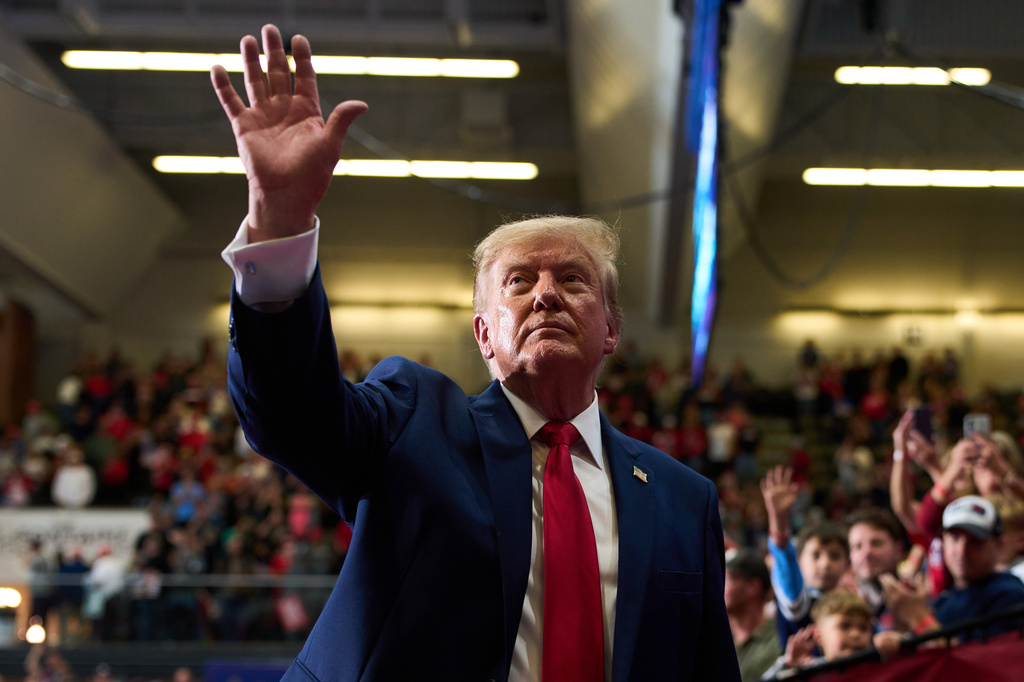
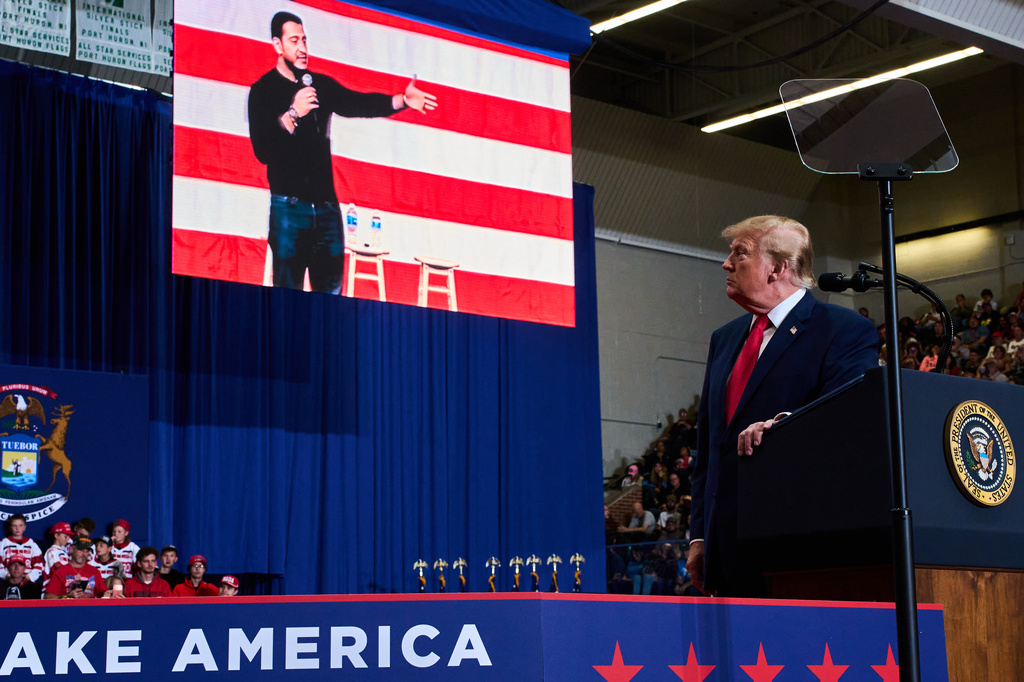
During a campaign event in Michigan, Donald Trump escalated his criticism of Democratic U.S. Senate candidate Abdul El-Sayed, labeling him a “jihadist” and attempting to link him to violent extremist movements.
“My goal is to prevent a jihadist and Muslim Brotherhood affiliate from entering the United States Senate,” Trump stated on October 25, later specifying his target as Abdul Mohamed El-Sayed.
Trump connected El-Sayed to the Muslim Brotherhood—an Islamist political organization established in Egypt nearly a century ago—and alleged that he and his relatives harbor extremist views. Although Republican figures in the Senate race have frequently raised questions about El-Sayed’s associations, Trump’s rhetoric stood out for its severity, even drawing comparisons between El-Sayed and the 9/11 hijackers.
At the gathering, Trump was joined by the father of Todd Beamer, a Michigan native who lost his life on United Airlines Flight 93 after passengers confronted the hijackers on September 11.
“A quarter-century later, the people of Michigan must rise and confront this threat—just as Todd did—to block a jihadist from reaching the Capitol,” Trump remarked.
El-Sayed is competing against Republican candidate and former U.S. Rep. Mike Rogers, who appeared alongside Trump at the Port Huron rally, for the seat currently held by retiring Democratic Senator Gary Peters.
Trump asserted that El-Sayed cannot be trusted with classified information, claiming he would be the sole senator required to pass through a metal detector. He also alleged that El-Sayed aims to implement Shariah law in the United States—a claim that fact-checkers have thoroughly debunked as entirely false.
Jihadism is defined as an ideology supporting the use of military force to advance Islam within society and governance. El-Sayed has never espoused such views, nor is he affiliated with the Muslim Brotherhood, an entity primarily active in the Middle East.
The White House did not provide documentation to support Trump’s allegations. Addressing the claims during an October 26 press conference in Detroit, El-Sayed dismissed the accusations as “baseless diversions and fabrications.”
Understanding the Term “Jihadist”
Jihadism generally refers to a militant worldview focused on enforcing Islamic governance through force, a term commonly associated with terrorist networks like al-Qaida and ISIS.
“There is zero legitimate justification for applying this label to El-Sayed,” noted Mohammad Hassan Khalil, a professor of religious studies and director of the Muslim studies program at Michigan State University.
El-Sayed has consistently emphasized his commitment to the religious freedoms guaranteed by the U.S. Constitution, and his platform does not include imposing religious law or promoting violence.
“In my view, this is a textbook instance of anti-Muslim prejudice and fear-driven rhetoric,” Khalil stated.
Clarifying the Muslim Brotherhood Connection
The Muslim Brotherhood operates through various regional chapters across the Middle East, each with distinct leadership structures and ideological leanings.
While these factions generally advocate for conservative religious principles and Shariah-compliant societies, and some offshoots have been linked to conflict, the main Egyptian branch officially renounced violence decades ago.
Nathan Brown, a professor of Middle Eastern politics at George Washington University, explained that each national branch functions as a distinct organization with formal membership and recruitment procedures.
Born and raised in Michigan, El-Sayed is not a member of the organization, has explicitly rejected it, and denies any association with the group.
“If he had ever been affiliated with them, his positions—such as advocating for LGBTQ rights, which run contrary to their platform—would have resulted in his expulsion,” said Juan Cole, a University of Michigan historian specializing in Islamic and Middle Eastern studies. “The entire narrative is completely fabricated.”
Certain international chapters of the Muslim Brotherhood have been classified as terrorist organizations by the U.S. government, including the Egyptian and Jordanian branches, due to their support for militant groups like Hamas.
Examining Past Statements on Egypt’s Political Transition
During his Michigan speech, Trump referenced El-Sayed’s historical writings, claiming he had signed a document endorsing the Muslim Brotherhood and calling for the removal of journalists and law enforcement.
In November 2012, El-Sayed was among 46 Egyptian Americans who signed a statement supporting Mohamed Morsi, a leader affiliated with the Muslim Brotherhood who became Egypt’s first democratically elected president following the overthrow of long-serving ruler Hosni Mubarak.
“He achieved office through the only democratic election in Egyptian history,” Cole observed. “El-Sayed’s support for Morsi at that time reflects a commitment to democratic governance rather than a specific endorsement of Morsi’s political party.”
At the time, Morsi had enacted a temporary decree protecting his executive actions from judicial oversight while a new constitution was drafted. The document signed by El-Sayed supported that temporary measure while calling for those powers to be relinquished once the constitution was finalized. It also included language criticizing parts of the state apparatus perceived as loyal to the previous regime. Brown noted that while the letter was partisan and pro-Morsi, it did not constitute an endorsement of the Muslim Brotherhood’s broader ideology.
Furthermore, in an earlier essay for The Huffington Post, El-Sayed advocated for the pro-democracy protests that sparked the uprising, arguing that fears of a potential Islamist takeover should not deter American support for democratic reform.
Fact-Check Summary
Trump’s assertion that El-Sayed is a “jihadist Muslim Brotherhood member” is entirely unfounded.
El-Sayed has never promoted jihadist ideologies, has formally distanced himself from the Muslim Brotherhood, and holds political positions that contradict the group’s agenda.
Because this claim relies on xenophobic tropes without any factual backing, it earns our lowest rating.