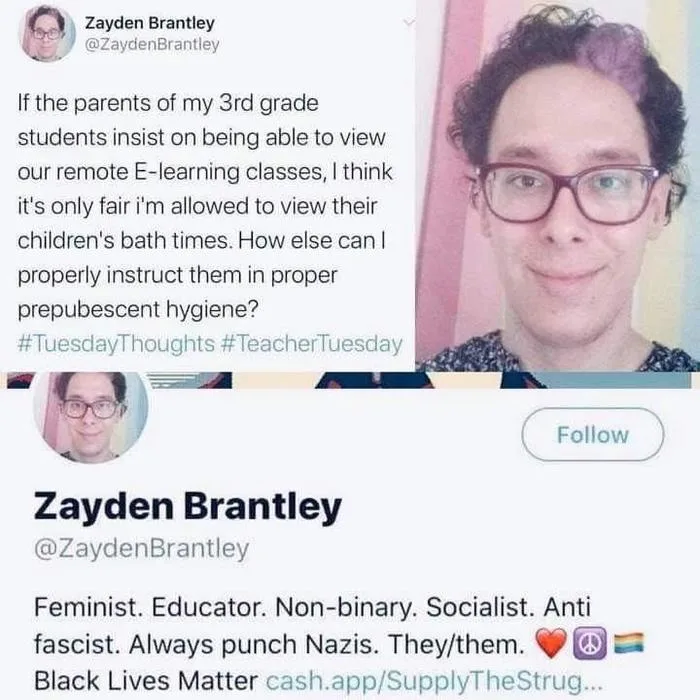
A controversial Twitter profile called “Zayden Brantley” has resurfaced online years after the account was reportedly deleted, with social media users once again sharing screenshots claiming the account belonged to a real non-binary anti-fascist public school teacher posting disturbing and sexually explicit political content.
But according to multiple fact-checks and archived reporting, the account was not authentic.
Researchers and fact-checkers say the “Zayden Brantley” profile was a fake persona that circulated online as political rage bait before being removed around 2020.
What Was the “Zayden Brantley” Account?
The account portrayed itself as:
- a non-binary public school teacher
- anti-fascist (“antifa”)
- politically far-left
- openly sexual and provocative online
Screenshots attributed to the account included:
- explicit political statements
- inappropriate comments allegedly about students
- inflammatory ideological posts
- exaggerated identity-based rhetoric
The profile became widely shared in conservative online spaces, where many users cited it as evidence of supposed extremism inside public education systems.
However, investigators later found major signs the account was fabricated.
Why Fact-Checkers Say It Was Fake
According to fact-check reporting, the account showed multiple characteristics commonly associated with troll or disinformation accounts:
1. No Verifiable Identity
There was never credible evidence linking the profile to:
- a real teacher
- a school district
- verified employment records
- authentic personal history
Despite the account going viral repeatedly, no confirmed real-world identity emerged.
2. Extreme Stereotyping
Many of the posts appeared designed specifically to inflame political audiences by combining nearly every culture-war stereotype into a single profile.
The account presented itself as:
- radically political
- sexually inappropriate
- aggressively ideological
- openly hostile toward critics
That combination caused some researchers to suspect the account was engineered specifically to provoke outrage and maximize sharing.
3. The Account Was Deleted Years Ago
Reports indicate the original profile disappeared around 2020, but screenshots continued circulating online long afterward.
That pattern is common with viral misinformation:
- old screenshots
- reposted without context
- detached from original sources
- repeatedly reshared during political debates
Once screenshots escape into meme ecosystems, they often continue circulating indefinitely even after accounts disappear.
Why the Story Keeps Coming Back
The “Zayden Brantley” screenshots continue resurfacing because they touch several highly emotional political topics at once:
- education
- gender identity
- public schools
- sexuality
- political extremism
Content combining those subjects tends to spread rapidly on:
Social media algorithms heavily reward emotionally triggering content, especially when it confirms existing political beliefs.
Rage-Bait Accounts Are a Growing Problem
The fake “Zayden Brantley” account fits into a larger trend sometimes described as:
- rage bait
- engagement farming
- political trolling
- synthetic personas
These accounts are often designed to:
- provoke outrage
- generate screenshots
- increase political polarization
- farm engagement and reposts
Some are created by trolls seeking attention, while others may be part of coordinated disinformation campaigns.
In many cases, the goal is not persuasion — it is emotional reaction.
Why Verification Matters
One major issue with viral screenshots is that they are easy to fake or remove from context.
Without:
- archived verification
- official records
- authentic video
- confirmed identity
- platform verification
there is often no reliable way to prove screenshots represent a genuine person.
That does not mean every viral screenshot is fake, but it does mean screenshots alone are weak evidence — especially in politically charged situations.
The Bigger Pattern Online
The “Zayden Brantley” story reflects a broader internet trend where fabricated personas are used to intensify political division.
Similar fake accounts have appeared online impersonating:
- teachers
- activists
- veterans
- immigrants
- religious groups
- political supporters
The objective is often to create the impression that an entire group behaves in extreme or offensive ways.
Researchers studying online misinformation have repeatedly warned that emotionally manipulative identity-based content spreads unusually fast online because it triggers anger and tribal reactions.
Bottom Line
The viral “Zayden Brantley” Twitter profile depicting a pervy non-binary anti-fascist teacher does not appear to have belonged to a verified real public school teacher.
Fact-checkers and researchers describe the account as a fake or troll persona that circulated online before reportedly being deleted around 2020.
Despite that, screenshots from the account continue resurfacing years later because outrage-driven political content remains highly shareable online.