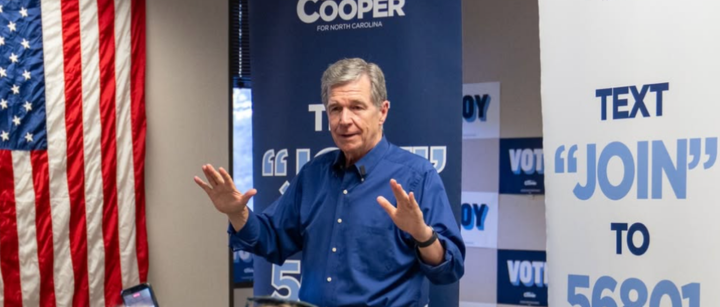
An advertisement funded by a Republican super PAC backing Senate candidate Michael Whatley features a deeply emotional account from a father whose daughter was tragically killed in 2025. The campaign spot suggests that the alleged killer was freed under pandemic-era prisoner release policies enacted while Roy Cooper, Whatley’s Democratic opponent, served as North Carolina’s governor.
However, the facts do not support this narrative. The suspect in the murder was released from a correctional facility in South Carolina, not North Carolina, meaning Cooper had no involvement whatsoever in his release.
The Ad’s Claims
The commercial, produced by the Senate Leadership Fund (SLF) PAC, stops just short of directly blaming Cooper for the young woman’s death while strongly implying a connection.
In the spot, Stephen Federico, whose 22-year-old daughter Logan was murdered in 2025, speaks tearfully about the home invasion. He describes the assailant pulling his daughter from bed, forcing her to her knees, and shooting her. Federico calls his daughter “a casualty of an agenda,” adding, “Roy Cooper let 3,500 criminals out on the street; 18 of them were murders. Forty years of Roy Cooper is enough.”
The reference to “3,500 criminals” stems from a court settlement during the COVID-19 pandemic, but the ad omits crucial context. As governor, Cooper initially opposed releasing inmates to address public safety concerns. This stance led to a lawsuit by the American Civil Liberties Union and other advocacy groups. When a judge issued a preliminary injunction and ordered the state to formulate a plan to lower prison density, Cooper agreed to a settlement releasing 3,500 individuals. None of those released, however, was Alexander Dickey, the man accused of killing Logan Federico.
While South Carolina did not accelerate prisoner releases during the pandemic, numerous other states—including Arkansas and Iowa under Republican governors—did implement similar policies to lower prison populations.
When contacted, the SLF PAC did not respond to inquiries about the advertisement. Meanwhile, a spokesperson for Cooper’s Senate campaign called the attacks entirely false, noting that the crime took place in South Carolina and was committed by a local criminal, with a Republican super PAC exploiting the tragedy for political advantage.
Cooper and Whatley are competing for the open Senate seat being vacated by retiring Republican Senator Thom Tillis. The Cook Political Report lists the race as the seat Democrats have the highest probability of flipping.
The Murder of Logan Federico
Logan Federico lived in North Carolina but was visiting friends in Columbia, South Carolina, when she was shot and killed during a home invasion. The suspect, Alexander Dickey, possessed a significant criminal record in South Carolina.
A criminal history report obtained by Columbia’s WIS News 10 indicated that Dickey had faced nearly a dozen arrests and roughly 40 charges prior to the murder, including robbery and burglary. A subsequent investigation by the station in June 2025 uncovered systemic flaws that may have led to a shorter sentence in 2023 for a conviction that could have kept him incarcerated much longer.
Dickey had been arrested on a burglary charge in 2023 and pleaded guilty to a first offense of third-degree burglary, despite having a prior conviction for the same charge dating back to 2014. The local solicitor’s office stated they were unaware of his past convictions due to missing records. Consequently, instead of facing up to 10 years in prison, Dickey accepted a plea deal for time served—411 days awaiting trial—and received probation.
The South Carolina Law Enforcement Division (SLED) explained that it never received the fingerprints from Dickey’s 2014 arrest, keeping his prior record hidden from prosecutors. Had they known, prosecutors stated he would not have been treated as a first-time offender and would have likely received a stiffer sentence.
Following his daughter’s death, Stephen Federico became a vocal advocate for keeping repeat offenders behind bars. In April, lawmakers introduced “Logan’s Law,” a bill aimed at creating a public violent offender database to hold lenient judges and prosecutors accountable, alongside a federal report investigating data-sharing deficiencies between states.
Ultimately, while South Carolina’s record-keeping failures may have left Dickey out of prison when the murder occurred, North Carolina and Roy Cooper had no connection to the situation.
Context on Pandemic-Era Releases
In the SLF ad, Stephen Federico calls his daughter a “casualty of an agenda” before pointing to Cooper releasing 3,500 prisoners, a talking point Whatley has also emphasized on the campaign trail.
While thousands of prisoners were indeed released early during the pandemic, Cooper’s administration fought against these reductions before being compelled by the courts. On April 20, 2020, the ACLU, NAACP, and several inmates sued Cooper and state prison officials, arguing that failing to reduce prison populations amid COVID-19 violated the state constitution’s ban on cruel or unusual punishment.
A Wake County Superior Court judge ruled in favor of the plaintiffs in June 2020, ordering a plan to reduce overcrowding. By December 2020, a special master was appointed to review home confinement programs. This culminated in a February 2021 settlement where the state agreed to early releases for 3,500 individuals over six months, a fraction of the 18,000 requested by plaintiffs. At that time, over 9,500 inmates had contracted COVID-19 in North Carolina prisons, and 47 had died.
The Cooper campaign noted that state officials and parole officers utilized criteria similar to the federal releases authorized by President Donald Trump a year earlier via the CARES Act, which moved over 13,000 federal prisoners to home confinement. However, while the federal legislation barred violent and sex offenders, North Carolina’s plan ultimately included some violent offenders scheduled for release in 2021 who had already served their minimum sentences. Reports indicated this pool included 51 inmates serving life sentences who were already eligible for parole prior to the agreement.
The settlement drew criticism from Republicans who felt the administration should have continued fighting in court. Conversely, plaintiffs’ advocates described Cooper’s administration as consistently resistant, noting that meaningful releases only occurred due to sustained litigation.
Regarding the ad’s claim that 18 of the released prisoners were murderers, the figure originates from a May analysis by the New York Post asserting that nearly half of the 3,500 released inmates reoffended, with 18 charged with murder in the subsequent four years.
An investigation by the journalism outlet The Assembly found the Post‘s framing misleading. It noted that over 90% of the roughly 3,000 inmates released early under the settlement would have completed their sentences by the end of 2021 anyway through good behavior credits and accelerated parole. Furthermore, the Cooper campaign pointed out that more than half of the 18 individuals cited as murderers allegedly committed those crimes after their original, pre-settlement release dates, with at least seven already out of prison before the agreement was even signed.
Whatley campaign representatives maintained that Cooper chose to settle rather than fight the legal battles in court, resulting in thousands of convicted criminals returning to the streets.