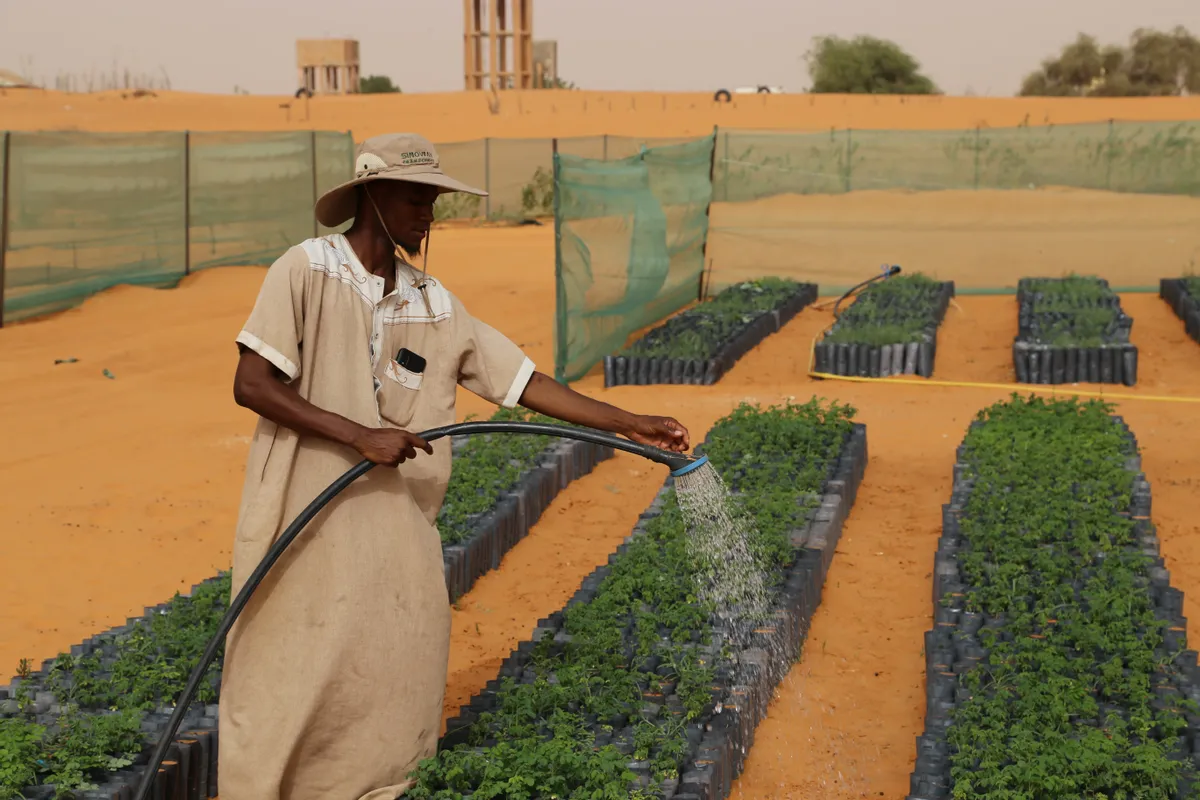
A coalition of more than 20 African nations has united to halt the northward expansion of the Sahara Desert by planting a continuous wall of trees stretching approximately 7,000 kilometers from coast to coast across the continent.

Launched in 2007, this multinational African initiative was originally envisioned as a continuous green barrier spanning the entire width of the continent to combat desertification. Over time, the strategy has evolved to encompass localized, multifaceted environmental and agricultural restoration programs rather than a single line of trees. While the official target length was set at 8,000 km, subsequent evaluations indicate that the ambitious venture has faced significant hurdles and achieved limited overall progress.
For several years, viral imagery depicting a lush band of greenery cutting across the African landscape has circulated online, highlighting an ambitious environmental undertaking known as the “Great Green Wall.”
Conceived in 2007, the initiative brings together numerous nations across the Sahel—the semi-arid belt situated directly south of the Sahara—with the primary objective of reversing desertification exacerbated by climate change.
Social media users across platforms like Facebook, X, and Threads have widely shared descriptions of the continental effort:
Across Africa, more than 20 countries are building something extraordinary together: the Great Green Wall. This massive belt of trees stretches from coast to coast along the southern edge of the Sahara, designed to stop the desert’s spread and restore land that’s been degraded for generations.
But here’s what makes this different from other environmental projects. It’s not just about planting trees—it’s about restoring livelihoods for millions of farmers and communities who depend on this land. It’s about fighting climate change by creating ecosystems that actually support people, not just preserve them behind barriers.
Imagine a living wall visible from space, built not to divide but to heal and unite an entire continent. That’s the cultural shift we’re witnessing: when nations choose collaboration over isolation, when environmental action becomes community action.

(Facebook user Culture Collective)
These claims are largely accurate regarding the existence of a collaborative continental initiative, though projections concerning the final length of the barrier differ. According to recent journalism, the broader project is frequently viewed as falling short of its grand expectations, with only isolated pockets of success.
Data from the United Nations Convention to Combat Desertification notes that the campaign aims “to restore Africa’s degraded landscapes and transform millions of lives in one of the world’s poorest regions, the Sahel. Once complete, the Wall will be the largest living structure on the planet – an 8,000 km natural wonder of the world stretching across the entire width of the continent.”
The original blueprint intended for the green belt to extend from Senegal on the Atlantic coast to Djibouti on the Red Sea by 2030. Archived materials from the project’s foundational outlines emphasize the severe environmental pressures driving the campaign:
The catalyst for the Great Green Wall is the daily impact of desertification and climate change that is undermining the futures of millions of communities across Africa’s Sahel region.
Since the 1970s, the Sahel has been heavily affected by recurrent periods of drought. These droughts have threatened the livelihoods and future of entire populations across the region.
The lack of rain has led to the disappearance of livestock and the destruction of cereal crops. The great famines that rocked the Sub-Saharan region in the 80s each affected millions of people. In addition, the high population growth rate is increasing demand for food and pressure to gain access to other natural resources which are the basis for livelihoods and the survival of the rural population.
Millions of people – particularly rural youth – are currently facing an uncertain future due to the lack of decent rural jobs and continuous loss of livelihoods due to land degradation and falling yields.
Despite these motivations, an investigative Associated Press review from 2021 revealed that a substantial portion of the saplings planted since 2007 failed to survive due to rising temperatures and diminishing rainfall. With only a fraction of the original targets met and an estimated $43 billion required for completion, implementers have pivoted away from a rigid wall of trees toward a more flexible “mosaic” approach, favoring community-centered agricultural and land-restoration techniques.
Prior reports highlighted notable national milestones: Senegal introduced roughly 12 million resilient trees in under a decade, Nigeria rehabilitated 5 million hectares of compromised land, and Ethiopia restored 15 million hectares. Furthermore, an evaluation published in Nature Sustainability in November 2021 pointed to the long-term economic viability of large-scale ecosystem restoration:
The Great Green Wall programme is a colossal initiative to restore 100 million hectares of degraded ecosystems across 11 countries in the region […] We evaluated the economic costs and benefits of future land restoration projects under this programme. We applied different scenarios that account for both market-priced and non-market benefits from restored ecosystems and consider the heterogeneity of local decision-making contexts in terms of investment planning horizons, discount rates, and the time needed for the restored ecosystems to start yielding their benefits in full. The results show that every US dollar invested into land restoration yields on average US$1.2 under the base scenario, ranging from US$1.1 to US$4.4 across the scenarios. At most, ten years are needed for land restoration activities to break even from the social perspective, accounting for both market-priced and non-market ecosystem benefits. To fund all proposed land restoration activities, an investment of US$44 billion is needed under the base scenario (US$18–70 billion across scenarios).
The study also cautioned that ongoing regional conflicts within the Sahel threaten to restrict operational access to vast areas of vulnerable land.
While the partnership initially comprised 11 nations, participation has since expanded to include more than 20 African countries. A promotional video from September 2020 showcased several localized efforts:
More recent assessments, such as a 2026 NPR investigation evaluating specific projects across Senegal, Chad, and Djibouti, characterize the campaign as a cautionary case study impacted by logistical hurdles and inconsistent local engagement, noting that a significant share of surveyed planting sites struggled to achieve long-term viability.