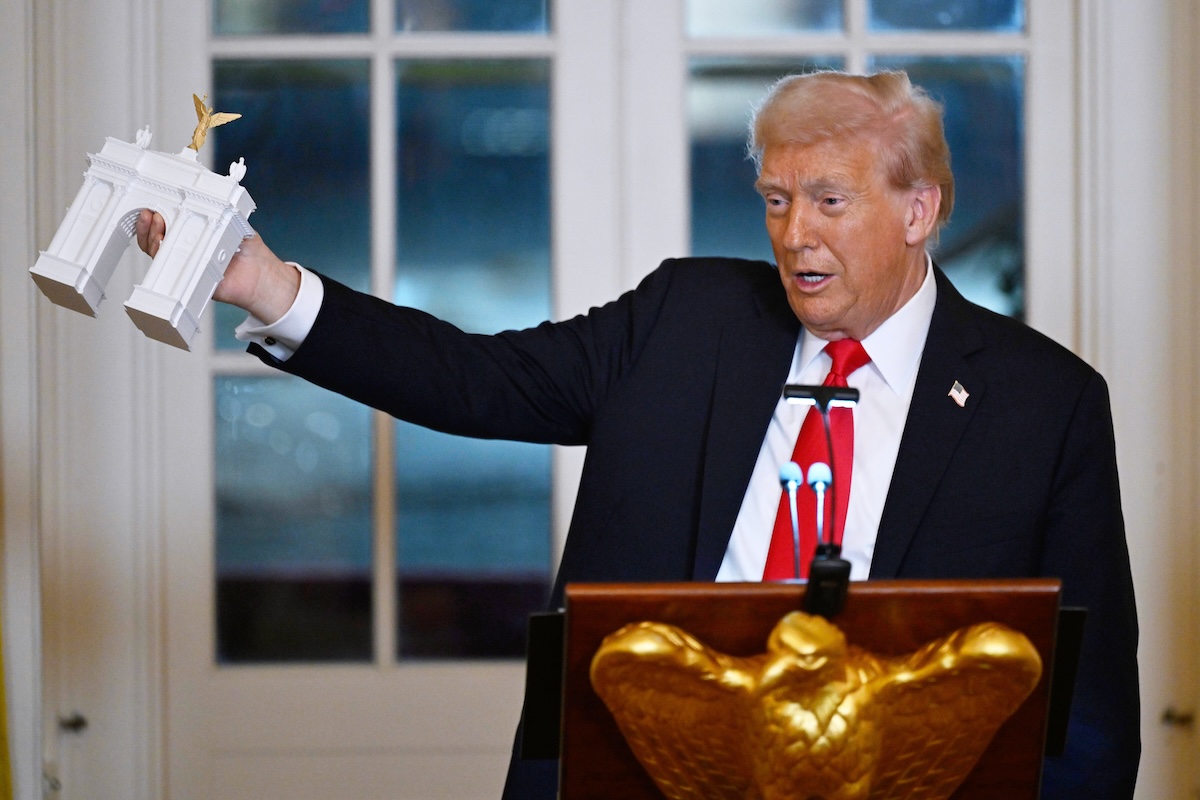
President Donald Trump has redefined his planned 250-foot monument in Washington, D.C., designating it as a “military complex.” This shift marks the second instance where the administration has altered the classification of a contentious building initiative by linking it directly to national defense.
In a Sept. 20 Truth Social update, Trump explained that the military requested the adjustment. The updated plan converts the triumphal arch into a secure facility designed to house and deploy drones, station snipers on the roof and plazas, and maintain a reserve of sniper ammunition.
Originally envisioned as a Memorial Circle landmark to commemorate the nation’s 250th anniversary, the massive structure has faced pushback regarding its proportions and how it might obstruct views of nearby historic sites like the Lincoln Memorial and Arlington National Cemetery.
Prior to this latest announcement, the venture was projected to cost roughly $100 million.
Legal challenges have slowed the progress; a group of Vietnam veterans initiated a lawsuit in February, arguing that federal regulations mandate congressional authorization for monuments built on National Park Service property in the capital. As of Sept. 21, the initiative remains subject to a judicial injunction and still requires clearance from the National Capital Planning Commission.
The following sections trace how the stated purpose of the arch has shifted over time and draw parallels to other administration construction efforts.
A grand monument for the nation’s 250
The arch concept was first introduced in mid-October 2025, accompanied by design mockups featuring eagles and a golden winged figure. When reporters inquired about the intended recipient of the monument, Trump responded simply, “Me.”
Advocating for the project, Trump pointed out that Washington lacked a triumphal arch compared to global capitals like Paris, Rome, and London. Discussions included adding public observation decks, and officials pressed to initiate groundwork quickly to ensure substantial framing ahead of the July semiquincentennial festivities.
Amid rising opposition, Trump claimed in February that a similar structure had been attempted centuries prior, noting that it was derailed by the Civil War.
However, historians dispute this account, pointing out that the capital was largely undeveloped during that era, with residents focused on addressing infrastructure and housing shortages rather than decorative memorials.
Historical records from The Associated Press show that the closest Washington ever came to such a structure was a temporary wood-and-plaster installation erected in 1919 to celebrate the end of World War I.
A national security necessity
Faced with ongoing legal challenges regarding the project’s authorization, the administration adjusted its messaging regarding the construction’s intent.
Interior Secretary Doug Burgum noted on Sept. 3 that excavation was poised to begin. In response, plaintiffs secured a temporary restraining order from a federal judge, as reported by Reuters. Shortly after, a National Park Service review published Sept. 15 recommended pausing for further evaluation, citing potential negative impacts on nearby historic assets.
Just five days later, the designation changed to a dual-purpose military installation. Designating a site for national security purposes typically grants it greater judicial deference, potentially bypassing historic preservation mandates and empowering the administration to argue that court intervention could impede defense capabilities.
A comparable rationale was used regarding the White House ballroom project—which resulted in the rapid demolition of the East Wing—amid a separate lawsuit and at least $300 million in taxpayer expenditures.
Initially, the ballroom was promoted as a privately financed addition intended for hosting international dignitaries, an amenity proponents argued past administrations had sought for over a century and a half.
Following a judicial order halting the ballroom construction in March—which restricted activity to essential security maintenance—the administration maintained that work should proceed because the space would also function as a secure facility integral to national defense.
RELATED: We crunched the numbers: Trump devoted 45,000 words to construction like Reflecting Pool, ballroom