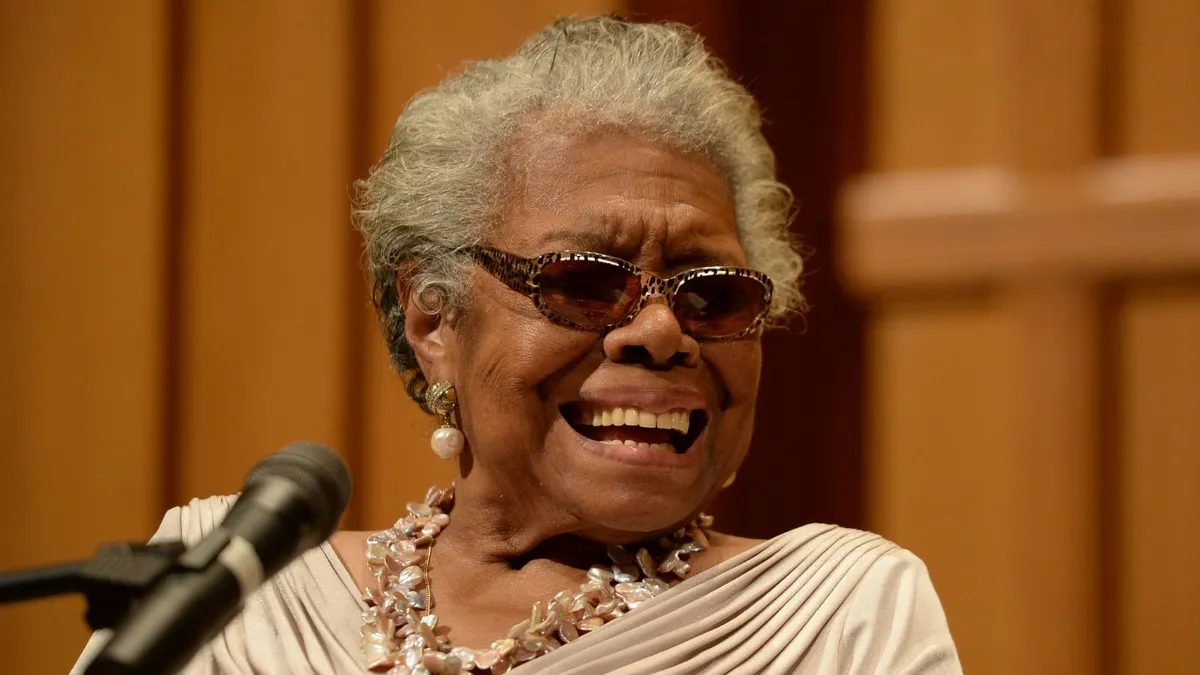
Poet and author Maya Angelou said or wrote, “Forgive yourself for not knowing what you didn’t know before you learned it.”

Social media users have circulated graphics and posts for years attributing the quote, “Forgive yourself for not knowing what you didn’t know before you learned it,” to the celebrated writer and poet Maya Angelou, who passed away in 2014.
A notable example surfaced on Facebook on October 4, 2023, when a user paired the text with a portrait of Angelou.

(Ravenous Butterflies accessed via Facebook)
The exact phrasing has frequently appeared alongside Angelou’s name across various platforms, including Facebook, Goodreads, Instagram, Reddit, X (formerly Twitter), and YouTube.
Ultimately, there is no verification that Angelou ever uttered or penned those words. Instead, investigation traces the origin of the quote to author Doe Zantamata.
Archival searches on X reveal that the earliest instance of the standalone quote—without any mention of Angelou—was posted on July 18, 2013. The attribution to Angelou did not surface on the platform until a tweet shared on November 6, 2015.
The July 2013 post originally directed users to a Pinterest pin watermarked with “thehiyl.com,” which links to Zantamata’s “Happiness in Your Life” blog. Zantamata published the quote on her blog days earlier on July 9, taking personal credit for the sentiment. Shortly after, the phrase was picked up and reshared by the official Facebook page for late motivational speaker Zig Ziglar.

(Doe Zantamata accessed via Pinterest)
Zantamata confirmed her authorship in an email correspondence, detailing the creative spark behind the text. Literary archives, newspaper databases, and video caption search tools consistently show that any association with Angelou only appeared well after the poet’s death.
Zantamata’s Inspiration
Zantamata explained that she first released the quote through her blog in July 2013 and later featured it in one of her books. According to her, the false attribution took off following Angelou’s passing:
There was a flurry of online articles, tributes, and quote posts going up all over social media. One day I saw my quote with her name as the author. I commented on the post, and my comment was deleted. This then happened several more times, and then I gave up trying to correct them.
First I was a bit flattered that someone would mistake my work for hers, but then after awhile people would comment when I posted my own quote and claim it was Maya Angelou!
Regarding her inspiration, Zantamata noted that the concept came to her while contemplating self-forgiveness:
I was writing some things about self-forgiveness, and had the realization that you can’t hold yourself responsible for what you couldn’t possibly have known. You had to learn it first. So there shouldn’t actually be anything to forgive yourself for in those cases since you weren’t knowingly doing something wrong. I distilled it down to a shorter quote.
Variations of the Misattributed Quote
Misattributions continue to evolve. In August 2026, an Indian media outlet featured a “quote of the day” that erroneously credited Angelou with a slight variation: “Forgive yourself for not knowing what only time could teach.” Digital archives indicate this specific wording did not exist prior to late 2025—more than a decade after Angelou’s death.
Angelou’s Actual Views on Self-Forgiveness
While Zantamata coined this specific wording, Angelou did discuss similar philosophies regarding grace and self-forgiveness during her life.
In a 1990s interview with youth advocate Linda Wolf—published in the 1997 book Daughters of the Moon, Sisters of the Sun—Angelou offered a parallel perspective:
WOLF: After all you’ve been through, including being raped as a child, how did you continue to have good feelings for yourself, to like yourself?
ANGELOU: I don’t know if I continue, even today, always liking myself. But what I learned to do many years ago was to forgive myself. It is very important for every human being to forgive herself or himself because if you live, you will make mistakes – it is inevitable. But once you do and you see the mistake, then you forgive yourself and say, “Well, if I’d known better I’d have done better,” that’s all. So you say to people you think you may have injured, “I’m sorry,” and then you say to yourself, “I’m sorry.” If we hold on to the mistake, we can’t see our own glory in the mirror because we have the mistake between our faces and the mirror; we can’t see what we’re capable of being. You can ask forgiveness of others, but in the end the real forgiveness is in one’s own self…
Additionally, a 2013 post from Angelou’s official Twitter account touched on a similar theme, quoting her as saying, “You forgive yourself for every failure,” drawing from an interview with Oprah Winfrey.
Earlier Historical Precedents
Historical database searches reveal that similar sentiments appeared decades prior. A May 1975 interview in a California newspaper featuring communications consultant Theodora W. Wells recorded a nearly identical philosophical gem: “It is okay to forgive yourself for not knowing yesterday what you know now. But let us be sure to take today.”