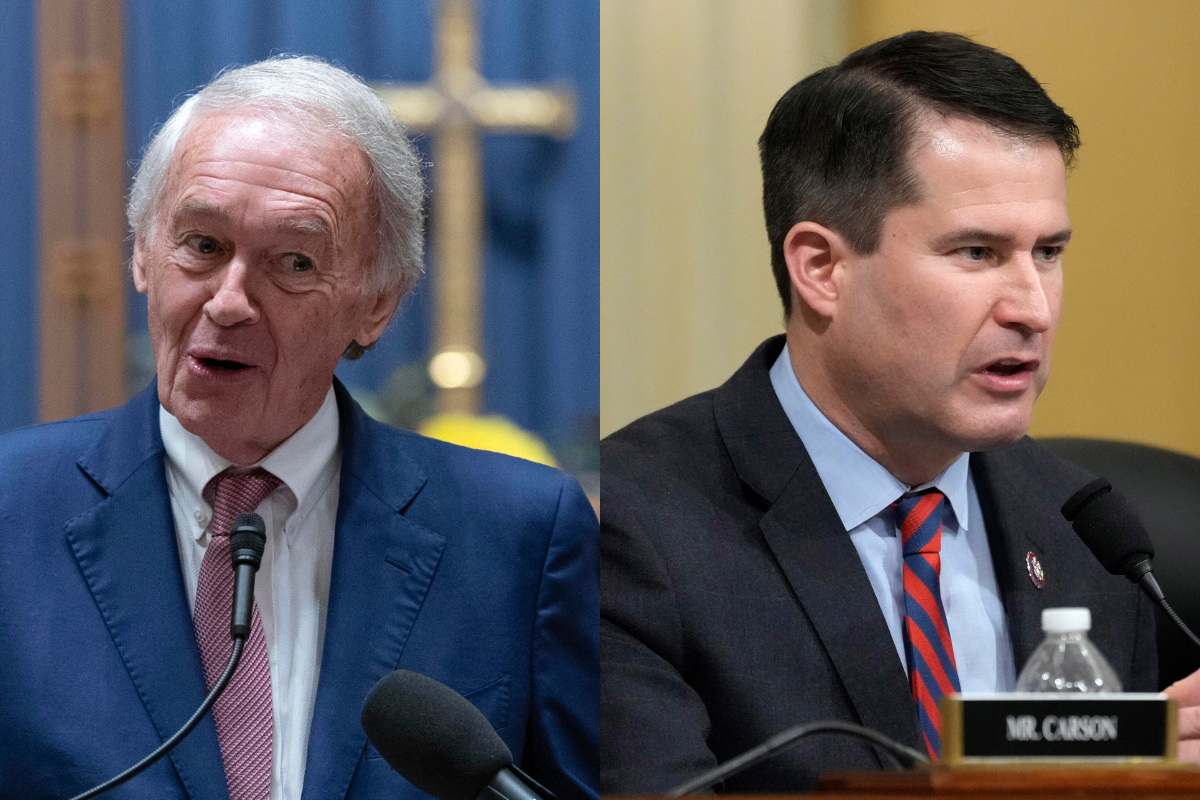
During a contentious Massachusetts Democratic primary debate for the U.S. Senate, incumbent Sen. Ed Markey and U.S. Rep. Seth Moulton exchanged traditional campaign barbs while also clashing over an unexpected and explosive topic: an alleged tie between Markey and the late convicted sex offender Jeffrey Epstein.
Raising the issue during the showdown, Moulton pointed out that Markey’s name surfaces in federal Epstein files in connection with a meeting involving a lobbyist who represented Epstein. Vehemently denying the claim, Markey fired back: “I have never met Jeffrey Epstein,” labeling both Epstein’s past behavior and Moulton’s line of questioning as “absolutely reprehensible.”
Beyond that confrontation, the matchup highlighted other areas of divergence between the two contenders, who otherwise share many similar policy viewpoints. The debate covered their respective campaign finance records, stock portfolios, and the stark generational gap between the 80-year-old Markey and the 47-year-old Moulton.
Hosted at WFXT’s studio in Dedham, the event was put on by WFXT Boston 25 and GBH News, alongside media collaborators El Planeta and the Bay State Banner.
As part of a collaboration with WCVB-TV, PolitiFact provided live coverage of the debate.
In the lead-up to the September 1 primary, PolitiFact evaluated several key flashpoints, including the Epstein accusation, the candidates’ willingness to share health records, Moulton’s positions on transgender policies, and their disagreement over Medicare for All.
Moulton to Markey: “Why would you even take a meeting with a lobbyist on behalf of Jeffrey Epstein?”
Moulton’s accusation stemmed from the federal government’s investigative documents regarding Jeffrey Epstein, who died by suicide in a jail cell in 2019. Simply appearing within these records does not imply any wrongdoing, as numerous politicians are mentioned without facing any criminal accusations or charges.
Pressing the issue, Moulton asked why Markey took a meeting with a lobbyist working for Epstein, questioning how such a meeting could happen well after Epstein’s initial conviction.
Reiterating his denial, Markey stated, “I have never met Jeffrey Epstein,” and condemned both Epstein’s actions and the nature of Moulton’s inquiry.
Records show that in 2015, Markey met with associates of lobbyist Bob Crowe to discuss Karim Wade—the son of the former president of Senegal who had been convicted of corruption in his home country. Department of Justice documents indicate that Crowe emailed meeting details directly to Epstein.
However, those files contain no proof that Markey was aware Epstein had any connection to Wade’s legal situation.
The 2015 meeting occurred roughly seven years after Epstein’s 2008 conviction for soliciting prostitution from a minor, and four years prior to his 2019 arrest on federal sex trafficking charges involving minors.
Reporting by the Miami Herald revealed that Epstein funded Wade’s legal defense and paid $100,000 to Crowe’s firm, Nelson Mullins, which lobbied lawmakers and the State Department to claim Wade’s prosecution was politically motivated.
At that time, Markey served as the ranking member on the Senate Foreign Relations Subcommittee on Africa and Global Health.
Additionally, Justice Department records show that one of Crowe’s partners extended an invitation to Epstein for a November 2015 Democratic Senatorial Campaign Committee fundraiser that featured Markey.
Markey subsequently urged the Trump administration to make the Epstein files public in 2025.
Markey: Moulton “has thrown those (transgender) kids under the political bus.”
In the wake of Donald Trump’s 2024 victory, Moulton remarked to The New York Times that Democrats often prioritize avoiding offense over addressing real challenges honestly. He remarked, “I have two little girls, I don’t want them getting run over on a playing field by a male or formerly male athlete, but as a Democrat I’m supposed to be afraid to say that.” Despite facing heavy backlash from party members, Moulton has consistently defended those statements.
At the same time, Moulton has co-sponsored the Equality Act, which seeks to add LGBTQ individuals as a protected group under the Civil Rights Act, and he voted against the Protection of Women and Girls in Sports Act, a bill aimed at excluding individuals assigned male at birth from female school athletic divisions.
During a town hall in January 2025, Moulton stated, “As a political party in the United States, we should welcome debate, we should entertain it. I don’t know what the exact right answer is on these contentious issues, but we should at least have the debate.”
In a March 2025 opinion piece, he wrote that he believed in implementing “reasonable restrictions for safety and fairness.” His position has drawn sharp reactions, including being booed by critics at a Boston LGBTQ pride parade in 2026.
Moulton: “I’ve offered to disclose my health records, (Markey) refuses.”
While accurate, submitting personal health logs is not a legal prerequisite for running for Congress.
Federal regulations established after the Watergate era mandate financial transparency for public officials, but they do not require medical disclosures.
The health and age of senators have become a prominent talking point following the July death of South Carolina Republican Sen. Lindsey Graham and as Kentucky Republican Sen. Mitch McConnell missed weeks of legislative duties following a fall that required hospitalization.
Moulton has publicly demanded that Markey release his medical history while pledging to do the same. Markey’s team has declined, dismissing the demand as a distraction from vital policy matters. As of mid-July, Moulton had not yet published his own medical files, though his campaign notified GBH that records had been requested through the Department of Veterans Affairs healthcare system, given Moulton’s service as a U.S. Marine Corps veteran.
Markey: Moulton “does not support Medicare for All.”
Markey’s statement is factual: unlike Markey, Moulton does not back a government-run, single-payer health insurance system designed to cover all Americans.
Markey is an official co-sponsor of the Senate’s 2025 Medicare for All legislation, whereas Moulton has not signed onto the companion House bill.
Markey has championed Medicare for All for years as a method to guarantee health coverage for every resident.
During his 2019 presidential campaign, Moulton similarly opposed the legislation, instead advocating for strengthening the Affordable Care Act and allowing citizens to keep their private health coverage. At the time, Moulton argued that forcing everyone onto a uniform federal program was not the right path forward.
“We need to make sure that everybody in America has access to quality affordable healthcare,” Moulton said in 2019. “And I don’t think we do that by forcing everyone onto a government one-size-fits-all program designed in 1963.”
Reiterating that view during the debate, Moulton argued that “health care, housing and education should all be human rights in our country. I think that after years of trying the senator’s plan, which has not gotten healthcare for all, we need a different approach that will bring down healthcare costs and ensure that everybody in America has healthcare.”