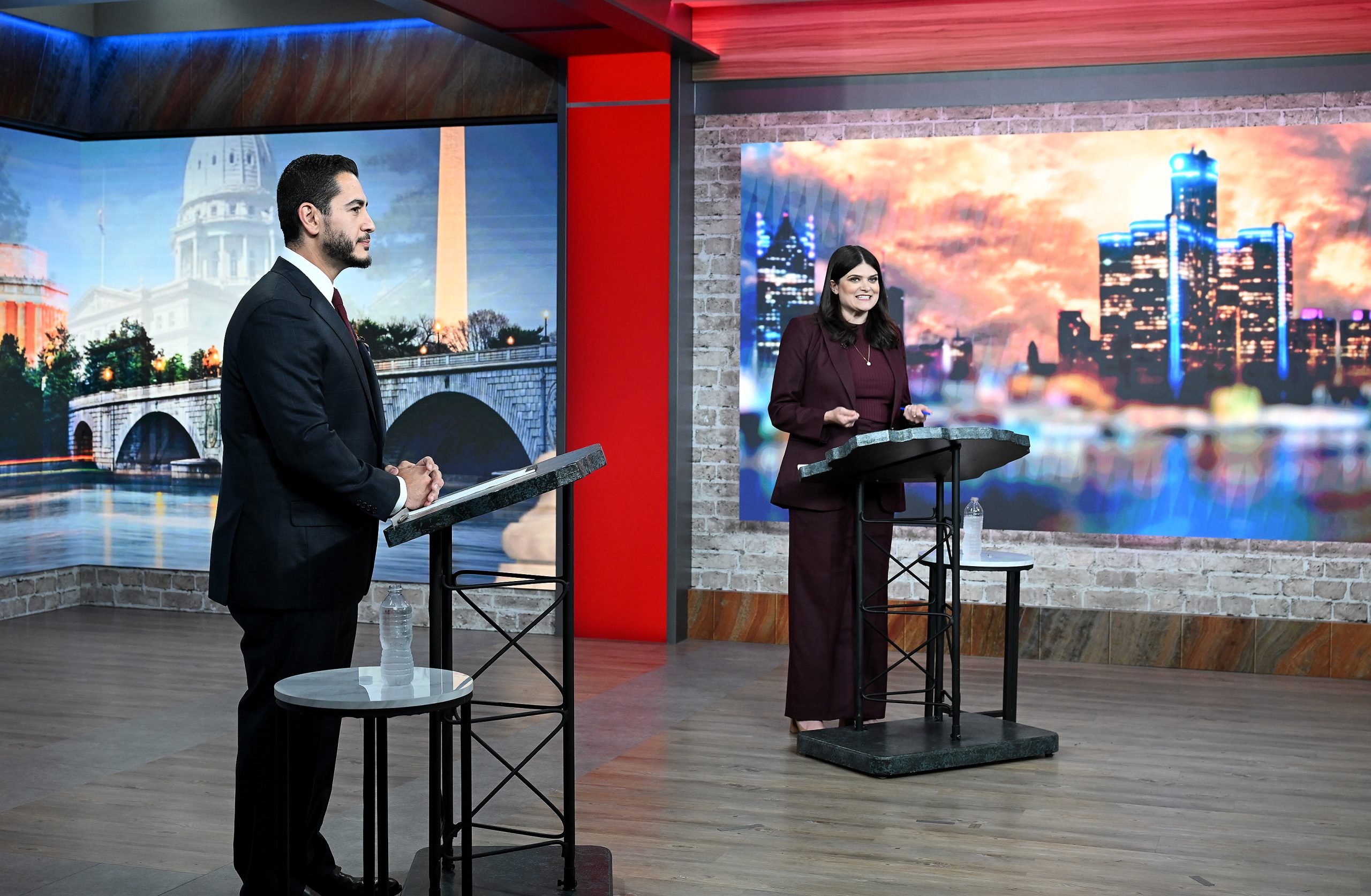
In their final debate before Michigan’s primary election, Democratic U.S. Senate candidates Abdul El-Sayed and Haley Stevens engaged in sharp exchanges over campaign finance, electability, and their visions for the state and the nation.
Stevens, billing herself as “Michigan’s manufacturing geek,” emphasized her commitment to defending the state’s industries against what she termed “Republican policies” and “trade wars” that disadvantage American workers. She vowed to stand up for Michigan against foreign economic pressures.
El-Sayed highlighted his progressive platform, focusing on affordability, universal healthcare, and reducing the influence of corporate interests in politics. He clarified his position, stating, “I’m not a socialist. I’m just a capitalist who understands how capitalism works,” and argued for government regulation to ensure fair participation in the economy.
This primary is a significant race nationally, as Democrats vie for control of Congress and seek to define the party’s direction. The open U.S. Senate seat, vacated by retiring Democrat Gary Peters, is crucial for the party’s ambitions. The winner will face former GOP Congressman Mike Rogers.
The debate saw endorsements from prominent Democrats: Stevens has backing from figures like Governor Gretchen Whitmer and Senator Peters, while El-Sayed is supported by progressive leaders such as Senator Bernie Sanders and Representative Alexandria Ocasio-Cortez.
A key point of contention was campaign funding. El-Sayed accused Stevens of accepting substantial support from outside groups, particularly those aligned with the American Israel Public Affairs Committee (AIPAC). He pointed to a vote Stevens took regarding foreign aid, linking it to significant Super PAC spending supporting her campaign. Stevens, in turn, acknowledged the broader issue of campaign finance reform and highlighted funding for a Super PAC supporting El-Sayed.
The candidates also debated their electability in the general election. Stevens cited a recording where the presumptive Republican nominee, Mike Rogers, suggested El-Sayed’s candidacy would benefit him. El-Sayed countered by questioning the necessity of extensive outside funding for a candidate. Public polls offer mixed indications regarding the general election matchups.
Additionally, the candidates addressed campaign funding from energy companies. When asked about accepting money from DTE or Consumers Energy, Stevens stated she was not taking money for her current Senate campaign, while El-Sayed brought up past contributions to her campaigns from DTE’s PAC. Stevens later clarified her response, referring specifically to her current Senate bid.
Personal wealth also became a topic, with Stevens positioning herself as the “only non-millionaire in this race” and criticizing El-Sayed’s delayed financial disclosure. El-Sayed’s filing revealed a net worth estimated between $700,000 and $2.1 million, including inherited properties. Stevens’ disclosure indicated a net worth not exceeding $376,998. Mike Rogers, the Republican candidate, is a millionaire, with his and his spouse’s wealth estimated between $7 million and $14 million.
Stevens also reiterated her claim of being “Michigan’s most effective Democratic lawmaker in Congress,” a designation supported by an analysis from the Center for Effective Lawmaking.
Reference