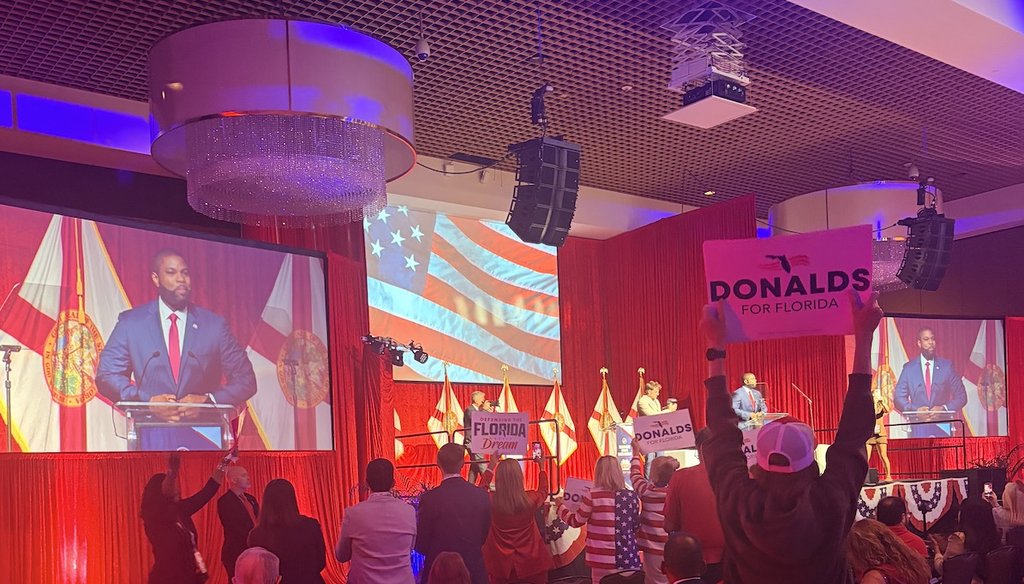
Florida Republicans gathered in South Florida on June 27 for an event they dubbed the "Sunshine State Showdown." For U.S. Rep. Byron Donalds, who was the featured speaker and the leading GOP contender for governor, the occasion felt more like a cordial discussion than a contest.
The event did not feature a debate among gubernatorial candidates. None of the other candidates met the party’s fundraising and polling thresholds required for a debate, and Donalds himself did not advocate for one.
Donalds took the stage at the Seminole Hard Rock Hotel & Casino following a video presentation that included an endorsement from the late Charlie Kirk, the founder of Turning Point USA. Donalds’ address did not mention his opponents. Instead, he responded to audience questions regarding the Second Amendment, his proposals to reduce homeowner’s insurance costs, and his plans to safeguard the state’s water supply. His responses were broad, offering little opportunity for specific factual verification.
Among the gubernatorial hopefuls present, Florida Lt. Gov. Jay Collins directly challenged Donalds on his record, highlighting a decades-old drug charge and campaign contributions from a super PAC supporting AI development. Former Florida House Speaker Paul Renner emphasized his legislative achievements, including a 2023 law he supported that restricts individuals from China and other "countries of concern" from owning or purchasing land in Florida.
The winner of the Aug. 18 primary is likely to face Democratic candidate David Jolly, a former congressman, in the general election.
Speakers made minimal reference to the party’s decision to withdraw an invitation from controversial gubernatorial candidate James Fishback, who held his own separate event nearby. The focus remained on themes of personal freedom and a shared sentiment against New York politics. U.S. Sen. Ashley Moody, while not naming her main Democratic opponent, described congressional race victors backed by New York City Mayor Zohran Mamdani as "anarchist psychos that want to destroy this country."
This report examines several claims made by speakers at the event:
Collins: Donalds voted "against military pay raises."
Collins selectively cited Donalds’ votes against defense spending bills that included military pay raises, while omitting instances where Donalds supported other measures that did authorize such increases. A similar statement by Collins was previously rated "Mostly False."
The National Defense Authorization Act is a comprehensive annual bill that governs funding and policy for the U.S. Defense Department. While it typically includes provisions for military pay raises, the legislation is extensive and authorizes significant funding for various military operations, often incorporating unrelated amendments. Donalds voted against this bill in 2022, 2023, and 2025, citing disagreements with provisions such as funding for Ukraine and climate change initiatives. He did, however, vote in favor of the package, which included pay raises, in 2021 and 2024.
Chief Financial Officer Blaise Ingoglia: Florida is "No. 1 in arresting and deporting criminal aliens in our communities."
While Florida ranks highly in arrests of non-citizens, it is not the leading state. Data for deportations is not directly comparable.
According to records from the Deportation Data Project analyzed by The Associated Press, Florida trails only Texas in arrests of non-citizens. Through "Operation Tidal Wave," a collaboration between Florida’s state and local law enforcement agencies and federal Immigration and Customs Enforcement (ICE), over 10,400 immigrants unlawfully present in the U.S. were arrested in Florida in 2025, according to state data.
In January, Governor Ron DeSantis announced an additional 9,600 arrests made through 287(g) agreements, which authorize state and local law enforcement to enforce certain federal immigration laws. Approximately 347 state and local agencies in Florida have entered into these agreements, the highest number of any state.
A Miami Herald analysis revealed that over 4,800 of the approximately 20,000 individuals had only immigration violations and no criminal charges or convictions. A quarter of those arrested had prior criminal convictions, and the remainder faced pending criminal charges, including nonviolent offenses.
Data indicates that ICE agents in Florida have made more immigration arrests in the current year than in any other U.S. region. As of March 10, the ICE field office in Miami, which covers Florida, Puerto Rico, and the U.S. Virgin Islands, recorded an average of about 120 arrests per day between December 19, 2025, and March 10, totaling 9,880 arrests, according to The New York Times.
U.S. Rep. Kat Cammack: "You should have to show an ID and you should have to be a citizen in order to vote."
U.S. citizenship is already a requirement to vote in federal elections. Instances of non-citizens voting are exceedingly rare.
States are responsible for establishing voter ID laws. Beginning January 1, 2027, the Florida Save Act will mandate that voters present photo identification, such as a valid U.S. passport or a state driver’s license, at polling places before casting their ballot. The use of student and retirement center IDs will be prohibited. The law also requires new Florida driver’s licenses and state-issued ID cards to indicate citizenship status. This measure is similar to the SAVE America Act, which was previously supported by former President Trump.
U.S. Sen. Rick Scott: In Colombia’s recent presidential runoff, "They counted the ballots and announced within three hours," contrasting this with California’s primary election results.
While Colombia does count ballots more quickly than California, the electoral processes in both locations are significantly different from the comparisons often made.
Colombia’s election featured only two candidates on the ballot and is administered at a national level, with no provision for mail-in voting. California’s June 2 primary election, where some results have taken extended periods to finalize, included multiple contests. Elections in California are managed by individual counties, and the majority of California voters cast their ballots by mail, a process that necessitates more time for processing and verification.