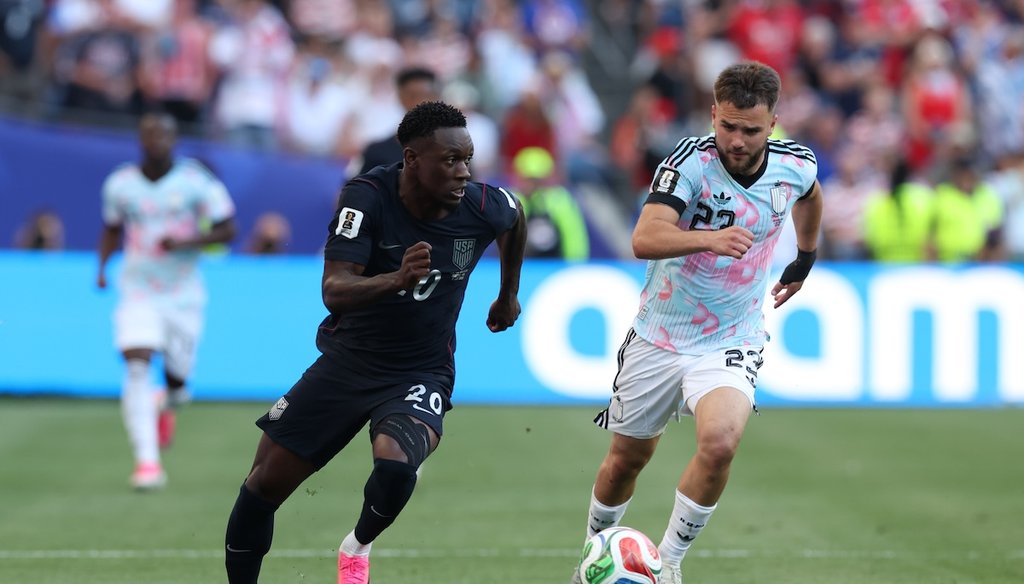
The U.S. men’s soccer team’s defeat to Belgium was followed by a storm of controversy surrounding a phone call President Donald Trump made to FIFA President Gianni Infantino. The call, made before the July 7 World Cup match, has led to calls for ethics investigations into both leaders’ actions.
The Genesis of the Controversy
The issue began when U.S. striker Folarin Balogun received a red card for an illegal tackle during the team’s 2-0 victory over Bosnia-Herzegovina on July 1. This resulted in an automatic one-game suspension for the U.S.’s leading goal-scorer. Following the match, U.S. Soccer Federation officials, with apparent backing from the White House, sought to appeal the suspension. The federation formally appealed to FIFA, arguing that video review should not have been used to determine the penalty. Notably, the referee for the match, Raphael Claus, had faced previous allegations of involvement in a match-fixing scheme, though FIFA stated no evidence of wrongdoing was found.
FIFA’s Decision and the President’s Reaction
On July 5, FIFA announced it had postponed Balogun’s suspension, allowing him to play in the knockout stage. The organization cited its Disciplinary Committee’s discretion under Article 27 of the FIFA Disciplinary Code, suspending the one-match ban for a probationary period of one year. President Trump publicly thanked FIFA for the decision, calling it a reversal of "a great injustice."
International Criticism and Investigation Calls
The ruling drew sharp criticism, particularly from Belgium, the U.S. team’s upcoming opponent. The Royal Belgian Football Association expressed concern for the integrity of the sport and stated they were exploring all potential options. Belgium’s head coach emphasized the need to safeguard fair play.
News of President Trump’s involvement broke after The New York Times reported on the call between him and Infantino, which occurred shortly after the U.S. vs. Bosnia-Herzegovina match. Infantino confirmed receiving the call, stating he explained the ongoing legal process within FIFA’s independent judicial bodies. The New York Times later reported a second call where Trump reportedly praised FIFA’s decision to delay the suspension.
Despite having Balogun available, the U.S. team did not advance, losing to Belgium and failing to reach the World Cup quarterfinals since 2002.
Historical Precedents for Red Card Reviews
The Balogun case marked a rare instance of a red card call being reviewed in a World Cup context. Historically, the most comparable event was the 1962 World Cup, where Brazilian star Garrincha received a red card. At that time, suspensions were not always automatic, and diplomatic efforts, including a petition co-signed by the Chilean President and a request from the Peruvian President to the referee, influenced FIFA to let Garrincha play, with Brazil going on to win the tournament.
More recently, FIFA has reduced red card suspensions during qualifying games. For example, Cristiano Ronaldo’s three-game ban for an elbow was partially delayed, allowing him to play in the World Cup. Similarly, suspensions for Nicolás Otamendi and Moisés Caicedo were waived before the 2026 World Cup openers.
Current Investigation Demands
The controversy has fueled existing concerns. In December 2025, FairSquare, a human rights organization in sports, filed an ethics complaint against Infantino for alleged breaches of political neutrality, also questioning FIFA’s decision to award Trump a "FIFA Peace Award." Over 50 members of the European Parliament supported this complaint.
President Trump’s intervention in the Balogun ban intensified FairSquare’s scrutiny. The organization announced plans to file a complaint with the International Olympic Committee (IOC) regarding Infantino’s alleged violation of IOC rules on political neutrality, as Infantino has been a member since 2020. The IOC has jurisdiction over such matters, though timelines for any investigation or potential action remain unclear. Additionally, 72 members of the European Parliament have called for an investigation into the reversed Balogun decision.