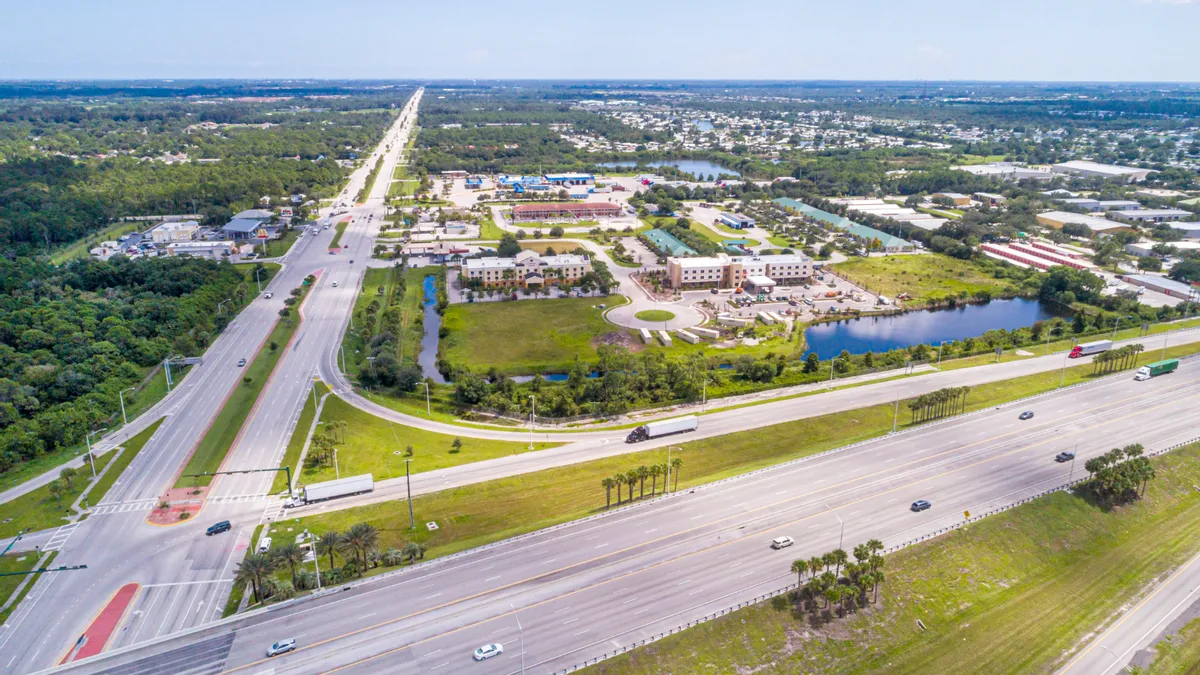
In January 2026, protesters “stormed” a planning and zoning meeting in Indian River County, Florida, to halt the development of a proposed Muslim municipality.

A large crowd of demonstrators did show up at an Indian River County planning and zoning session on Jan. 22, 2026, motivated by fears that a Muslim city was going to be built in the area.
No such city was ever planned. The panic stemmed from online rumors that mistakenly linked Epic Estates—a purely secular land banking firm operating in Texas and Florida—to EPIC City, an entirely separate Texas development associated with a Plano mosque.
By August 2026, viral claims began spreading across social media alleging that angry Floridians had “stormed” an Indian River County zoning meeting in an effort to thwart the creation of a Muslim enclave named “EPIC City” in Vero Beach.
Typical social media posts warned that the venue was packed to capacity with residents shouting slogans against the project. Similar versions of the narrative quickly gained traction across various online platforms.
While some aspects of the public outcry actually occurred, the underlying premises driving the panic were entirely fabricated.
It is true that a packed house filled the Indian River County Planning and Zoning Commission chambers on Jan. 22, 2026. Attendees were there to voice opposition to what online rumors described as an Islamist-backed project. These digital posts claimed that the organizers had already built a Muslim municipality in Plano, Texas, and intended to replicate the endeavor in Florida.
However, plans for an Islamic city in Indian River County were completely nonexistent. The online narrative had incorrectly conflated Epic Estates—a real estate holding company that buys and sells vacant land parcels across states like Texas and Florida—with EPIC City, a residential project near Dallas linked to the East Plano Islamic Center. Critics of the Texas venture had previously labeled it a “Shariah city.”
In a late January 2026 legal letter directed to Indian River County officials, attorneys for Epic Estates clarified that the two entities shared no common ownership or affiliation. They emphasized that Epic Estates’ commercial operations were strictly secular and that the company did not build or manage communities directly.
By March 2026, the company and its authorized representative, Venkatesh Yerramsetty, took legal action, filing a defamation lawsuit in a Florida circuit court against 11 parties they accused of spreading false information linking Epic Estates to the Texas initiative, resulting in substantial financial damages.
The Project Was Never on the Commission’s Agenda
Although social media mobilization successfully drove a massive crowd to the Jan. 22 commission meeting, local officials made it clear that the concerns were baseless.
Following the opening proceedings, Ryan Sweeney, the county’s assistant planning and services director, addressed the standing-room-only crowd to clarify that Epic Estates was not listed on the official agenda, and that no such entity as “Epic City” was proposed for the county. He dismissed rumors of a sudden new town, noting that a development of that magnitude would require immense public notice.
Sweeney explained that Epic Estates merely owned property within the county and had held preliminary, informal discussions regarding the potential division of their acreage into 10-acre tracts. He confirmed that no formal applications had been submitted to rezone or subdivide the property into smaller plots.
Social Media Amplification and Legal Fallout
The subsequent defamation lawsuit targeted several high-profile commentators and local figures—including media personality Dennis Michael Lynch and podcaster Joann Binford—for allegedly propagating misleading assertions tying Epic Estates to a radical religious agenda.
According to court documents, the false claims began circulating after Yerramsetty spoke at a September 2025 council meeting regarding agricultural zoning changes. Binford subsequently discussed the matter on her podcast, drawing parallels to the Texas development, which later prompted calls to action from local political committees and real estate professionals.
While some individuals named in the suit ultimately retracted their statements, Lynch shifted his public focus toward general zoning and land-use arguments.
Reflecting on the situation the day after the contentious meeting, Lynch noted that while community engagement is vital, his discussions with the landowner’s legal representation confirmed that the owner was neither Muslim nor associated with the Texas project.
Legal proceedings regarding the defamation suit remain ongoing.