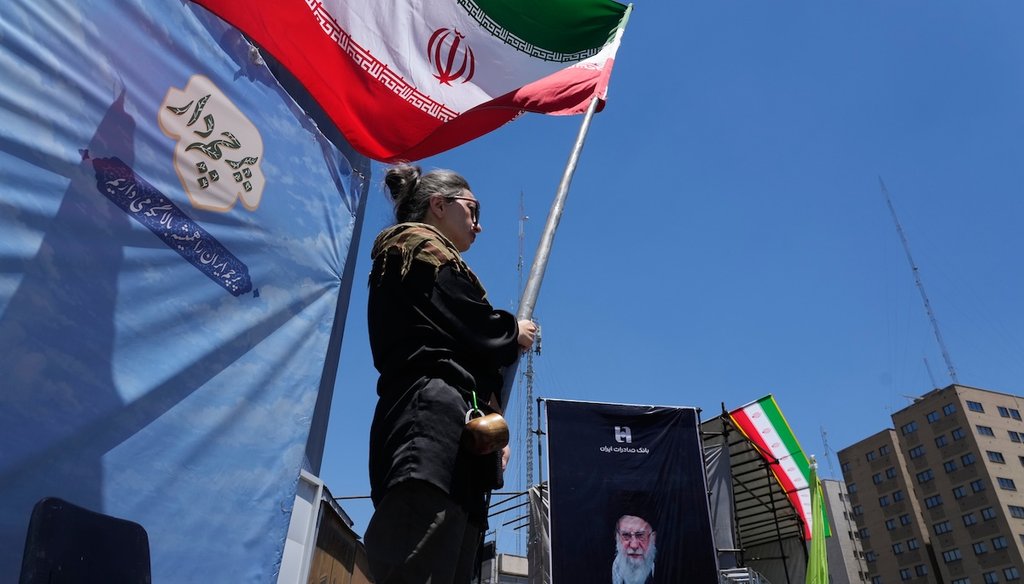
As President Donald Trump and the Iranian government finalized terms to end hostilities, Democrats raised concerns about a provision that appeared to allocate hundreds of billions of U.S. dollars to Iran.
Senator Amy Klobuchar, D-Minn., stated on X (formerly Twitter), “With $300 billion, we could end homelessness, fund cancer research for 40 years, and give every child free pre-K for over 7 years. Instead, Trump is sending it to Iran.”
Trump refuted these claims, posting on Truth Social on June 18, “There is no 300 Billion Dollar payment to Iran by the U.S. That’s Fake News! All there is for the U.S. is Success, Lower Oil Prices, and Victory.”
Verifying the accuracy of Trump’s statement is challenging. While numerous news organizations published a memorandum of understanding between the U.S. and Iran, they received the document from an anonymous source or senior U.S. official.
The cited memo stated, “The United States of America undertakes with regional partners to develop a definitive, mutually agreed plan with at least U.S.D. 300 billion for the reconstruction and economic development of the Islamic Republic of Iran.”
The Trump administration has since acknowledged the existence of a fund, asserting that taxpayer money would not be involved. When asked on June 18 about the funding for the $300 billion, Vice President JD Vance commented, “There is a great desire from the Arab world and from outside the Arab world to actually get involved in Iran if they behave properly.”
Vance pointed to the United Arab Emirates as an example. He explained that investments such as building a power plant are currently hindered by U.S. sanctions. “And so what we’re saying is that if you behave, and if the Emiratis themselves want to build a power plant, then we will do the sanctions relief necessary to make that possible.” He indicated that private funding would likely play a role, contingent on a significant shift in Iranian behavior.
Reuters reported on June 17, citing an anonymous source, that half of the fund had already been committed as a “private investment vehicle,” with no government funds or grants involved. According to Reuters, companies from the U.S., Gulf Arab states, Asia, South America, and Africa had agreed to invest in sectors like energy, manufacturing, and transportation. No public information identifying specific investors has been found. The memorandum indicates the deal could take up to 60 days to finalize.
A separate clause in the memorandum states that the U.S. will “make fully available for use the frozen or restricted funds and assets of the Islamic Republic of Iran.” The Wall Street Journal reported that the U.S. is collaborating with Qatar to grant Iran access to billions of dollars in frozen assets. However, Reuters’ reporting suggests that the funds released from lifting sanctions would be distinct from the proposed $300 billion investment fund.
The White House was contacted for further clarification but did not provide a response.
Reference