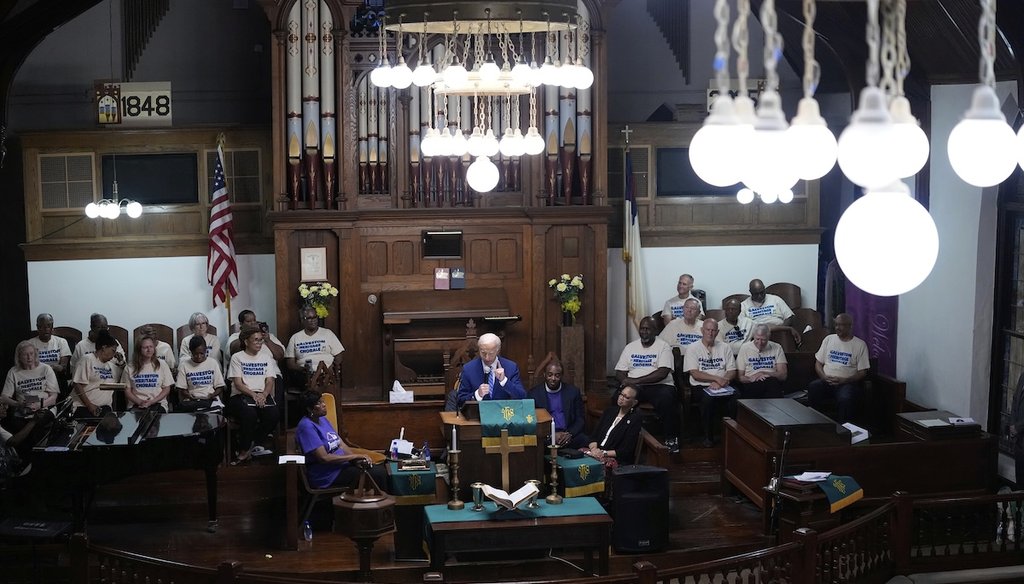
As the nation approaches its 250th anniversary, this year also marks the fifth year since Juneteenth was established as a federal holiday.
Juneteenth commemorates June 19, 1865, the day Union troops arrived in Galveston, Texas, to announce the end of slavery. On June 17, 2021, President Joe Biden signed legislation making Juneteenth the 11th federal holiday.
However, five years on, not all states observe Juneteenth as a paid holiday for their state employees. While federal holidays mandate paid time off for nonessential federal workers, individual states have the discretion to recognize which federal holidays they will honor.
Although Juneteenth is acknowledged in some form by every state, only 31 states, along with Washington, D.C., recognize it as a permanent paid holiday, according to a 2025 Congressional Research Service report. Alabama was the most recent state to enact this recognition in May 2025.
Some states that have not made Juneteenth a permanent holiday have found alternative ways to acknowledge the occasion. For instance, New Mexico must declare Juneteenth as a paid day off each year. In North Carolina, state employees can use a personal paid leave day for "cultural or religious importance" on Juneteenth.
In other states, such as Kansas and Kentucky, governors have declared the day a state holiday, but this status is not codified in local law.
Private companies are not legally obligated to give employees the day off. Nevertheless, an estimated 41% of employers with 500 or more employees do offer Juneteenth as a holiday, according to a 2024 survey by the consulting firm Mercer.
During his second term, the Trump administration has not made significant public statements regarding the holiday. Neither the White House nor former President Donald Trump offered celebrations for Juneteenth in 2025. The National Park Service also faced criticism from organizations like the NAACP when it removed Juneteenth and Martin Luther King Jr. Day from its list of free admission days to national parks. In their place, June 14—Flag Day and Trump’s birthday—was added.
While celebrations honoring African-American history will occur nationwide, Texas holds the distinction of commemorating Juneteenth longer than any other state.
The Genesis of Juneteenth and its Celebration
President Abraham Lincoln signed the Emancipation Proclamation in 1863. However, its realization in Texas, the Confederacy’s last stronghold, took over two years. The Civil War concluded on April 19, 1865, but enslaved people in Texas did not immediately receive news of the Confederacy’s surrender.
On June 19, 1865, Union General Gordon Granger arrived in Galveston. His troops proceeded through the city, reading General Order No. 3 at civic buildings and churches, formally declaring the emancipation of all enslaved people.
Historian Mitch Kachun, author of "First Martyr of Liberty: Crispus Attucks in American Memory," notes that awareness of Juneteenth spread across the country as Black individuals migrated from the South in the post-Civil War era. By 1920, over 17,000 Black Texans had relocated to other states. Thousands more moved further west during World War II to seek employment in defense industries.
"As Black Texans established new lives in different regions, they brought with them their ongoing struggles for economic and social justice, as well as their Juneteenth traditions," Kachun explained.
The social justice dimensions of Juneteenth became more pronounced through the 1950s and 1960s. The 1968 Poor People’s March on Washington further cemented the holiday’s connection to the Civil Rights movement.
The march, which began hundreds of miles from the nation’s capital a few weeks after the assassination of Rev. Martin Luther King Jr., drew inspiration from an Oklahoman account of a Black Union soldier who traveled on muleback to disseminate news of emancipation from Texas.
The march concluded with a ceremony on June 19, attended by approximately 50,000 people at the Lincoln Memorial.
Juneteenth.com, among various initiatives promoting the holiday’s recognition, points to the 1968 march as a catalyst for significant annual marches in Milwaukee and Minneapolis.
Following decades of informal observances, the Texas Legislature officially recognized Juneteenth as a state holiday in 1980, with the federal government following suit more than 40 years later.