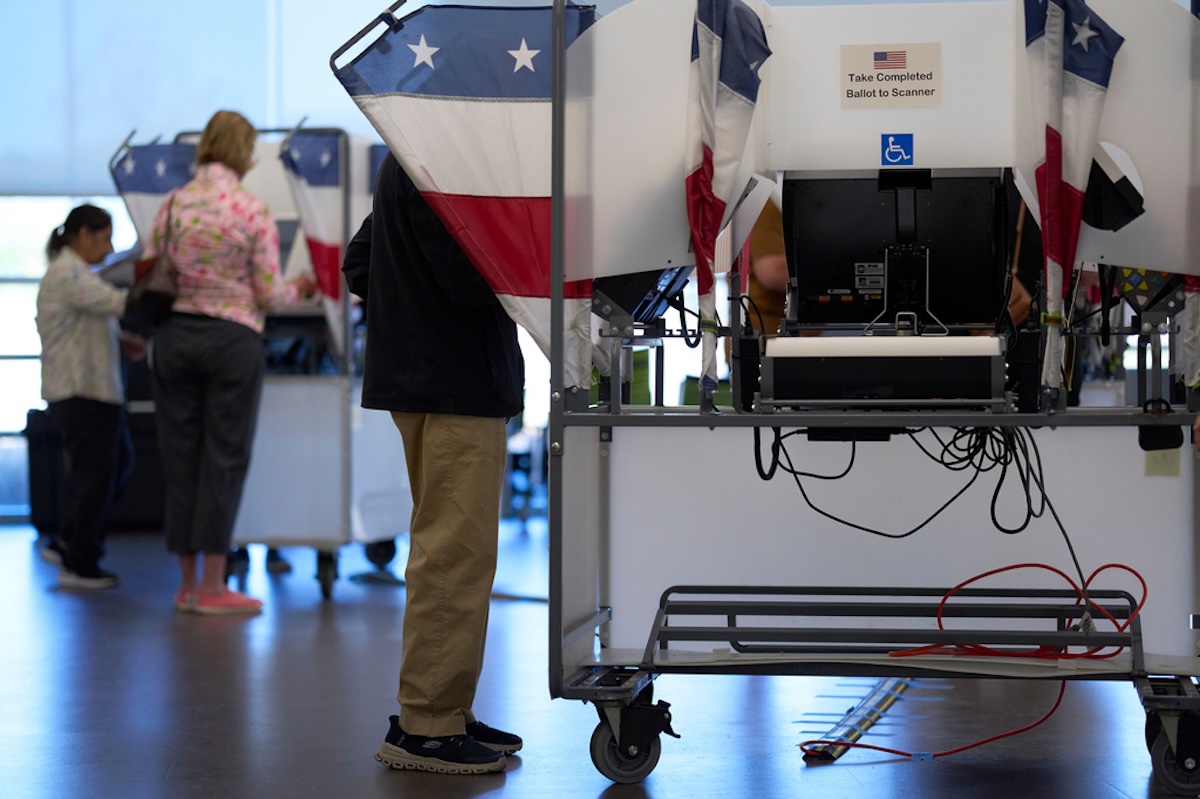
As early voting for the 2026 midterm elections progresses, social media is once again seeing a surge in unverified claims that electronic voting systems are actively altering or “flipping” citizen choices.
Reports of this nature have popped up across multiple regions.
A widely shared Facebook post from the progressive organization “The Other 98%” claimed, “There is a very disturbing trend being seen in early voting. Texas, Florida, Tennessee, Ohio are reporting difficulties getting the machines to accept Democratic votes. The machines change them back to Republican unless the voter persists, pressing several times to get the correct vote to go through.”
Similar narratives have also gained traction on X and TikTok.
While allegations of vote manipulation have become a frequent talking point following past election cycles, authorities emphasize there is zero evidence of widespread tampering or of hardware purposely built to subvert voter intent. Instead, experts note that such anomalies are typically tied to touch-screen sensitivity and user error.
Concerns in Tennessee and Texas Point to Calibration and Touch Sensitivity
Stella Parton, sister of music icon Dolly Parton, shared on Facebook on Oct. 21 that while casting her ballot at Nashville’s Hermitage Library, the interface “kept flipping to the wrong candidate.”
“I had to go back three times and correct my vote because it kept defaulting to Marsha Blackburn,” she wrote.
According to local outlet WSMV-TV, similar grievances were raised by Williamson County residents in Franklin, Spring Hill, and Nolensville, who noted discrepancies between their intended selections and what appeared on-screen. Additional complaints surfaced in Madison County.
Tennessee Coordinator of Elections Mark Goins addressed the reports by noting they likely stem from inadvertent screen touches rather than technical failure. He emphasized that all equipment undergoes rigorous pre-election testing, and noted that physical styluses are available upon request to assist voters with touch navigation.
The Tennessee Secretary of State’s office stated that out of approximately 400,000 ballots cast thus far, only a single complaint of this specific nature had been filed with their office.
Meanwhile, in Texas, KSAT-TV highlighted that three Bexar County voters experienced instances where choices seemed altered or cleared, though all were able to verify and correct their ballots before submission.
Bexar County Elections Administrator Michele Carew clarified in a statement, “Reports of mismatched selections are almost always due to user touchscreen sensitivity, not machine malfunction. Touchscreens require a firm, direct tap, and poll workers are trained to assist as needed.”
Carew also reiterated that these machines undergo strict accuracy testing and remain completely disconnected from the internet.
Although a Kendall County resident claimed online that a relative experienced repeated switching from Democratic to Republican candidates, Texas Assistant Secretary of State for Communications Alicia Pierce confirmed her office had received no official reports of that kind.
Pierce pointed out that Texas relies on hardware that does not digitally store direct vote selections (barring accommodations for voters with disabilities). The affected counties utilize systems designed strictly to print a physical paper ballot for review.
“Any machines must produce a human-readable paper ballot that a voter can review before casting. We encourage all voters to review their choices before finally casting their ballot,” Pierce added.
The jurisdictions experiencing these reports—including Williamson, Davidson, and Madison counties in Tennessee, as well as Bexar, Williamson, and Kendall counties in Texas—all utilize ExpressVote terminals manufactured by ES&S.
Katina Granger, an ES&S spokesperson, told PolitiFact that the company has not encountered widespread operational complaints. “Most commonly, reported instances stem from a voter not touching the text box in the correct place. They can touch anywhere inside the large box containing the candidate’s name,” she explained.
Older Footage Recycled Online
Along with new grievances, social media users have begun recirculating misleading, years-old video clips.
An X post from Oct. 23 features footage of a user tapping a candidate’s selection box while the screen registers a vote for the candidate listed above.
The accompanying caption asks, “Can you say national emergency? Electronic voting machine will not let voter select the Republican candidate that they want to vote for and automatically selects the Democrat candidate instead.”
In reality, that recording dates back to 2019, featuring gubernatorial primary contenders Tate Reeves and Bill Waller Jr. in Mississippi, a phenomenon previously debunked by fact-checkers years ago.
Similarly, another widely shared video from Oct. 22 displays an interface failing to align with a voter’s physical touch. However, this clip originated during the 2018 midterms involving a congressional race in Indiana between Jim Baird and Tobi Beck.
What Voters Should Keep in Mind Regarding Touch Screens
Discrepancies on digital ballots remain statistically uncommon, according to election technology representatives.
“Statewide and local officials have both repeatedly affirmed that nearly every case comes back to the screen calibration on older touchscreen machines, not a change to anyone’s vote,” noted Kristin Miles, president of the Texas Association of County Election Officials.
Voters who experience any technical hurdles are advised to immediately seek guidance from on-site poll workers prior to casting their ballots.
Elections administrators emphasize that individuals have numerous safeguards to confirm their choices. Selections are visible directly on the terminal, shown on a final summary screen, and printed onto a physical paper ballot for verification.
Should the printed document fail to match an individual’s intent, poll workers are available to assist in resolving the issue before the ballot is officially submitted.
“There is no scenario in which a voter would be forced to cast a ballot that they believe did not reflect their intentions,” Granger concluded.