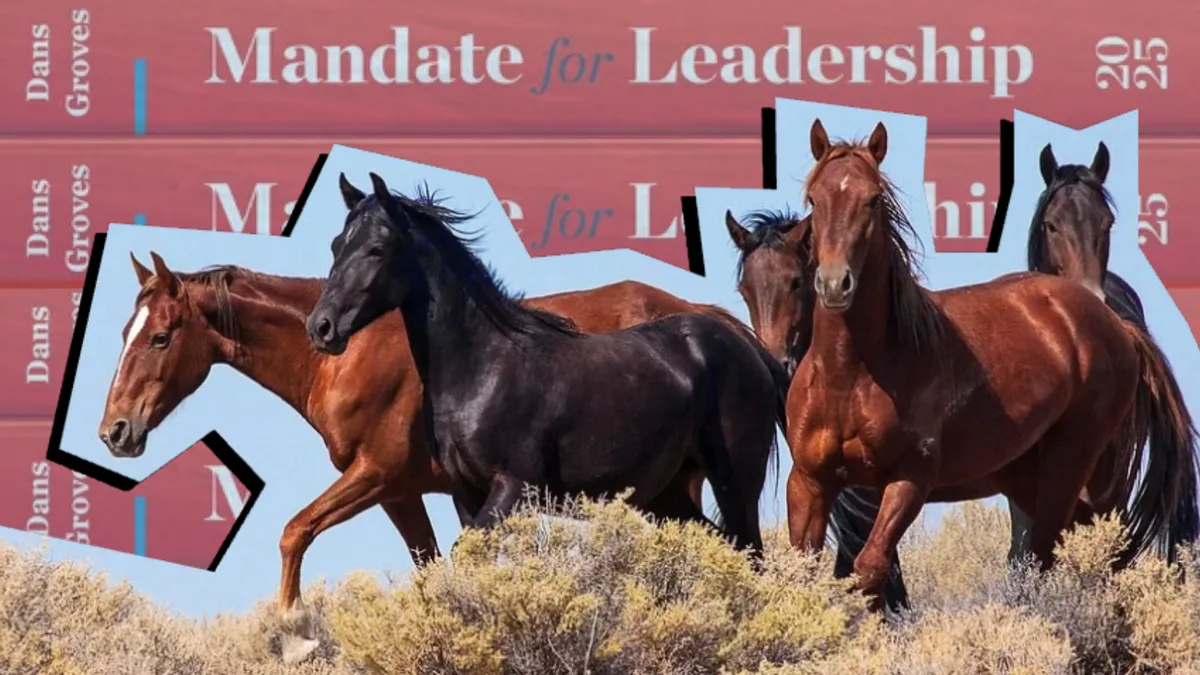
Following an August 2026 report by The New York Times suggesting that the Trump administration permitted protected wild horses to be sold to slaughterhouses, social media rumors quickly tied the move to Project 2025, alleging the conservative policy blueprint endorsed the practice as a way to trim government expenses.
While Project 2025—developed by the Heritage Foundation as a foundational guide for a second Trump term—does propose allowing the Bureau of Land Management (BLM) to “humanely” eliminate wild horses, its authors justify the culling as a method to combat severe overpopulation and protect delicate public ecosystems, rather than as a strict cost-cutting measure.
Although the document briefly touches on the taxpayer expense of maintaining the animals, it stops short of framing euthanasia as a financial solution. Because the exact intent behind the cost-reduction aspect remains ambiguous, the claim has been rated as a mix of accurate and unverified details.
Statements from Officials and Agencies
Both The Heritage Foundation and Dave Phillips, the New York Times journalist who broke the story, were contacted for comment. Meanwhile, the BLM issued an emailed statement denying any involvement in sending horses to slaughter:
“The Bureau of Land Management does not sell or send wild horses or burros to slaughter, and allegations that individuals are violating federal law or the terms governing the sale of these animals are taken seriously.”
The agency urged anyone possessing evidence of illegal activity to contact them directly at 1-866-468-7826 or via wildhorse@blm.gov.
Previous reporting noted that while the Times article provided compelling circumstantial arguments, it lacked definitive proof that the administration utilized a legal loophole to route wild horses to slaughterhouses.
What Project 2025 Proposes
The specific recommendations regarding wild horses appear on page 560 of Project 2025’s nearly 900-page “Mandate for Leadership.” The text highlights the escalating crisis of overpopulation:
- Ecological Strain: The document notes that over 95,000 wild horses and burros currently roam roughly 32 million western acres—triple the volume ecosystems can sustain. Herds are growing by 10% to 15% annually, outcompeting native wildlife, threatening endangered species, and damaging public and private lands.
- Welfare Concerns: Pointing to support from groups like the American Veterinary Medical Association and the ASPCA, the text argues that unchecked population growth leads to starvation and environmental degradation.
- The Proposed Solution: After acknowledging that current strategies—such as adoptions, contraception, and off-range holding facilities costing taxpayers nearly $50 million annually—are insufficient, the authors conclude: “Congress must enact laws permitting the BLM to dispose humanely of these animals.”
Despite mentioning the financial burden of off-range corrals, the report never explicitly states that euthanizing the horses is intended to save money. In fact, an earlier section on page 558 suggests the government might need to allocate more funds to resolve tough issues like wild horse management.
Project 2025 vs. Existing Federal Law
Managing wild horses has long been a complex challenge for the BLM. According to agency data, populations in nearly every tracked state far exceed sustainable environmental thresholds.
Interestingly, while Project 2025 urges Congress to greenlight humane culling, the legal framework to do so already exists. Under the Wild Free-Roaming Horses and Burros Act of 1971, the federal government is technically authorized to euthanize excess animals “in the most humane and cost efficient manner possible.”
However, a 2008 Government Accountability Office (GAO) report revealed that the BLM historically avoided this option due to anticipated public backlash. Instead, the agency spent $101 million—roughly 66% of its budget—on off-range pastures and corrals in fiscal year 2024 alone.
The BLM reiterated its statutory obligations in its statement: “When populations exceed what the land can sustainably support, animals can face inadequate forage and water, declining body condition and other serious consequences.”