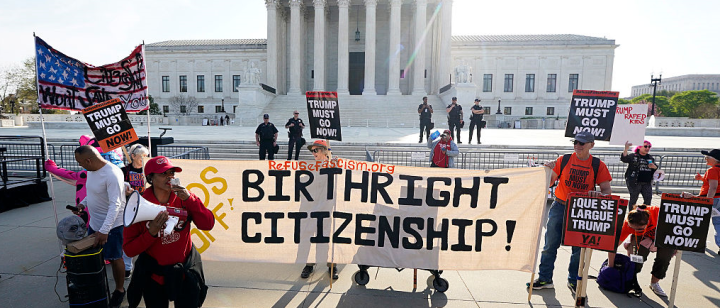
The Supreme Court’s recent decision affirmed that birthright citizenship, as defined by the 14th Amendment, applies to virtually all individuals born in the United States. This interpretation, according to constitutional and immigration law experts, means that ending birthright citizenship would necessitate a constitutional amendment, rather than simple legislation.
President Donald Trump had suggested that Congress could address the issue through legislation, bypassing a lengthy amendment process. However, legal scholars widely disagree. The 14th Amendment states, "All persons born or naturalized in the United States, and subject to the jurisdiction thereof, are citizens of the United States and the State wherein they reside."
An executive order issued by Trump in an attempt to alter birthright citizenship never took effect due to court challenges. The subsequent Supreme Court case, Trump v. Barbara, resulted in a majority opinion from Chief Justice John Roberts, who wrote that the promise of the 14th Amendment extended citizenship to all born in the country, including children of parents present unlawfully or temporarily.
Experts emphasize that the majority opinion provides no basis for Congress to alter birthright citizenship through a statute. While some have attempted to pass legislation to end birthright citizenship for children of undocumented immigrants, no such bill has ever been successful. Experts predict that any future legislative attempts would be struck down by the courts.
Garrett Epps, a constitutional expert and professor at the University of Oregon School of Law, stated that the majority opinion in Barbara does not suggest Congress has the authority to change birthright citizenship by statute. While Justice Brett Kavanaugh’s concurrence suggested Congress might have the power to create exceptions, this was not the view of the majority.
Muzaffar Chishti, a lawyer and senior fellow at the Migration Policy Institute, agrees that legislation cannot reverse birthright citizenship. He noted that the Supreme Court’s strong opinion indicated that only a constitutional amendment could reinterpret the 14th Amendment’s application to birthright citizenship, with the exception of children born to diplomats and enemy aliens.
Jorge Loweree of the American Immigration Council echoed this sentiment, explaining that the majority opinion relied on over a century of precedent, confirming that the 14th Amendment’s Citizenship Clause protects citizenship for nearly everyone born in the United States. Any congressional statute conflicting with this interpretation would likely face immediate legal challenges, as Congress cannot override the Constitution by statute unless the Supreme Court changes its stance.
Even some prominent Republicans who oppose birthright citizenship, such as Florida Gov. Ron DeSantis and Sen. Mike Lee, acknowledge that a constitutional amendment is now required. DeSantis stated that the decision was substantive, meaning the 14th Amendment mandates citizenship for those born to individuals present unlawfully, and that either a constitutional amendment or a future court ruling would be needed to change this. Sen. Lee called for a "long fight" for a constitutional amendment to explicitly exclude individuals who violate immigration laws.
The term "birth tourism" refers to pregnant women entering the U.S. on tourist visas to obtain U.S. citizenship for their newborns. While direct data on birth tourism is limited, some estimates suggest over 20,000 births per year. Actions such as restricting the entry of pregnant women, cracking down on birth tourism, or limiting the ability of birthright citizens to sponsor family members are potential legislative measures Congress could consider, according to some experts.
Andrew Arthur of the Center for Immigration Studies believes Congress could implement measures to address immigration fraud and misuse of the system without altering the Constitution, such as cracking down on birth tourism, which he notes is already a focus and against the law for those who facilitate it.
However, Samuel Breidbart, counsel in the Democracy Program at the Brennan Center for Justice, argues that any attempt to narrow eligibility for birthright citizenship would not hold unless a future Supreme Court reverses the current decision. He emphasized that there are five votes on the court affirming birthright citizenship as a constitutional right, and that a constitutional amendment is required to change it, not congressional legislation.
Evelyn Cruz, a professor and director of the immigration clinic at Arizona State University’s law school, suggested that Justice Kavanaugh’s suggestion of congressional action "stands on thin ice." She believes, however, that even if such legislation were ruled unconstitutional, it could still be politically useful by keeping the birthright citizenship issue viable for political purposes.