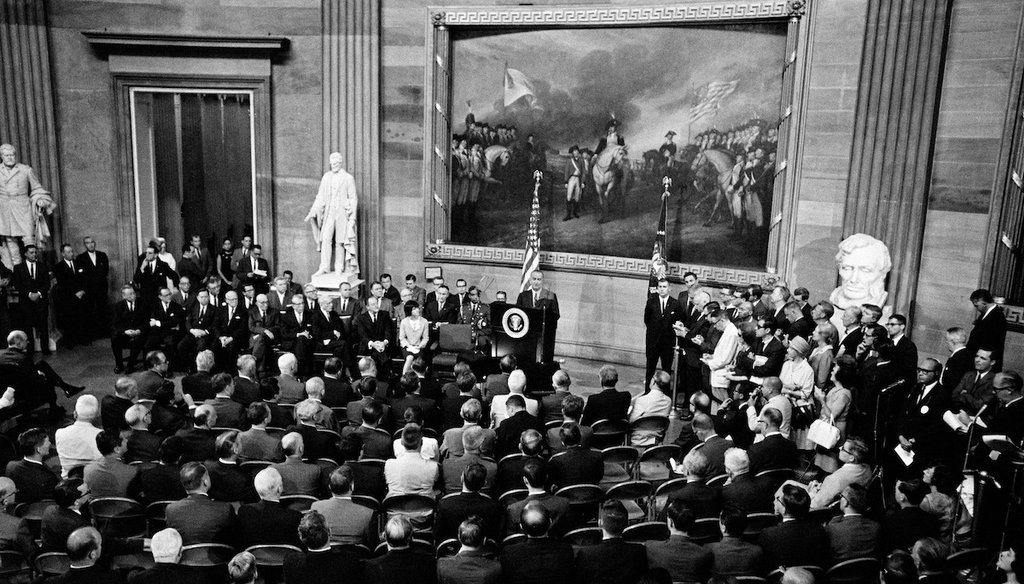
Rep. Byron Donalds recently claimed the 1965 Voting Rights Act was passed because Southern Democrats were racially gerrymandering districts to disenfranchise Black voters.
The statement quickly sparked debate online after Donalds defended a recent Supreme Court decision weakening parts of the Voting Rights Act.
But historians and voting rights experts say the claim is misleading.
While racial gerrymandering did exist in parts of the South, experts say it was not the primary reason Congress passed the landmark Voting Rights Act of 1965.
What Byron Donalds Said
During a May 2026 interview, Donalds argued:
Congress passed the Voting Rights Act because “the Democrat party at the time, especially in the South, were racially gerrymandering districts to disenfranchise Black voters.”
Donalds made the comments while discussing recent legal battles over redistricting and racial representation in congressional maps.
His remarks came shortly after the U.S. Supreme Court issued a major decision weakening key parts of the Voting Rights Act tied to racial gerrymandering claims.
Why Historians Say the Claim Is Misleading
According to historians interviewed by PolitiFact, the Voting Rights Act was primarily created to stop widespread voter suppression tactics targeting Black Americans — not mainly because of gerrymandering.
Experts said the biggest barriers Black voters faced in the Jim Crow South included:
- literacy tests
- poll taxes
- intimidation and violence
- grandfather clauses
- discriminatory voter registration systems
- outright denial of voting access
These tactics effectively prevented millions of Black Americans from voting for decades after the Civil War despite the 15th Amendment formally granting Black men voting rights in 1870.
PolitiFact quoted Harvard historian Alex Keyssar saying:
“The Voting Rights Act passed because, in most Southern states, Black Americans were not permitted to vote or even register to vote.”
Did Racial Gerrymandering Exist?
Yes.
Historians acknowledge that racially discriminatory district maps existed in the South and were sometimes used to dilute Black political influence.
However, experts say gerrymandering was only one part of a much broader system of racial disenfranchisement.
At the time the Voting Rights Act passed in 1965:
- many Black citizens could not vote at all
- Black voter registration rates remained extremely low in several Southern states
- segregation-era laws still restricted political participation
Because so many Black Americans were blocked from voting entirely, historians say other suppression methods were far more central to the law’s creation than district boundary manipulation alone.
What the Voting Rights Act Actually Did
The Voting Rights Act of 1965 became one of the most significant civil rights laws in American history.
Signed by Lyndon B. Johnson, the law aimed to enforce the 15th Amendment and eliminate discriminatory barriers preventing Black Americans from voting.
Key provisions included:
- banning literacy tests
- authorizing federal oversight of elections in discriminatory states
- protecting minority voter registration rights
- allowing federal intervention against racial discrimination in voting
The law dramatically increased Black voter registration and political participation throughout the South during the following decades.
Why the Debate Matters Again Now
Donalds’ comments emerged during renewed national battles over:
- congressional redistricting
- racial representation
- voting rights protections
- partisan gerrymandering
In April 2026, the Supreme Court significantly weakened part of the Voting Rights Act related to racial redistricting challenges. Critics say the ruling could make it easier for states to redraw maps that dilute minority voting power.
Following the ruling:
- Louisiana
- Tennessee
- Alabama
- Mississippi
and other states began considering new congressional maps that voting-rights advocates say could reduce Black political representation.
Supporters of the ruling argue courts had previously relied too heavily on race when drawing districts.
The Political Context Behind Donalds’ Claim
Donalds’ argument reflects a broader modern Republican effort to emphasize that many segregationist politicians in the South historically belonged to the Democratic Party.
That historical point is factually true:
many Southern segregationists during the Jim Crow era were Democrats.
However, historians caution that modern political parties underwent major ideological realignment during and after the civil rights era, particularly from the 1960s onward.
Because of that shift, experts say historical party labels alone do not fully explain modern political coalitions or civil-rights debates.
What Fact-Checkers Concluded
PolitiFact rated Donalds’ statement false because:
- racist gerrymandering was not the main reason the Voting Rights Act was passed
- the law primarily targeted broader systems of voter suppression
- historians said his explanation ignored the central role of literacy tests, poll taxes, intimidation, and racial violence
The fact-check acknowledged that racial gerrymandering existed, but concluded Donalds overstated its role in the creation of the law.
Bottom Line
No, the Voting Rights Act was not primarily created because Southern Democrats engaged in racial gerrymandering.
Historians and fact-checkers say the 1965 law was mainly designed to stop widespread voter suppression tactics that prevented Black Americans from registering and voting altogether.
Although racial gerrymandering existed during that era, experts say it was only one part of a much larger system of discriminatory practices targeted by the landmark civil rights legislation.
FAQ
Did Southern Democrats support segregation during the Jim Crow era?
Yes. Many segregationist politicians in the South were Democrats before the major political realignment of the civil rights era.
Was racial gerrymandering real in the 1960s?
Yes. Racially discriminatory district maps existed, but historians say they were not the main reason Congress passed the Voting Rights Act.
What was the main purpose of the Voting Rights Act?
The law aimed to stop discriminatory practices preventing Black Americans from voting, including literacy tests, poll taxes, intimidation, and racial violence.
Why is the Voting Rights Act controversial today?
Recent Supreme Court rulings and redistricting battles have reignited debates over racial representation, voting access, and congressional map drawing.