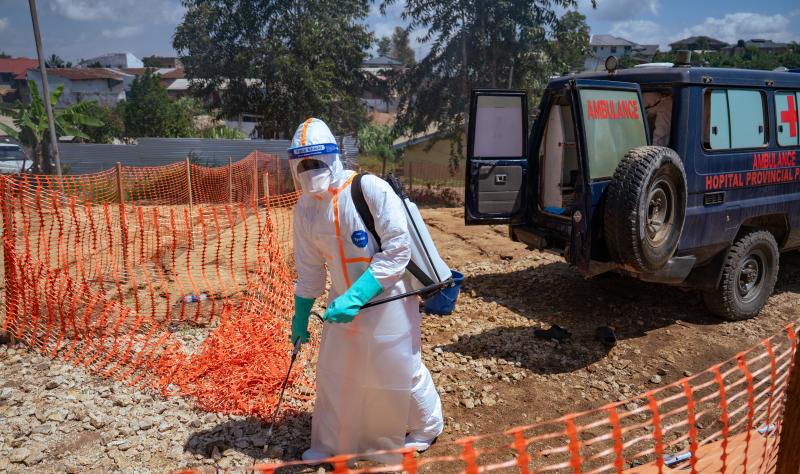
The Ebola outbreak in the Democratic Republic of the Congo (DRC) is potentially much more widespread than current figures suggest, according to a senior World Health Organization (WHO) official.
Chikwe Ihekweazu, the WHO’s executive director for the Health Emergencies Programme, informed Reuters that a significant number of new Ebola patients in Ituri province, the outbreak’s focal point, are not linked to known cases. This indicates that the Bundibugyo virus is spreading largely undetected.
Ihekweazu estimates that the actual number of cases could be two to four times higher than officially reported, based on modeling and test-positivity rates.
As of the latest daily update from BNO News, the DRC has recorded 1,792 confirmed Ebola cases and 625 deaths, resulting in a case-fatality rate of 34%. Neighboring Uganda has reported 20 confirmed cases and two deaths.
Wessam Mankoula, an epidemiologist with the Africa Centers for Disease Control and Prevention (Africa CDC), described the situation during a press briefing as the continent’s fastest-growing Ebola outbreak to date.
The current outbreak ranks as the third-largest on record. At its current trajectory, it could surpass the 2014-2016 West Africa outbreak and the 2018 North Kivu outbreak in the DRC. Mankoula presented data showing that in the first six weeks following its declaration in mid-May, the DRC outbreak saw 1,596 reported cases, compared to 994 in the initial six weeks of the West Africa outbreak and 378 in the North Kivu outbreak.
"Unfortunately, the virus is still ahead of our response," Mankoula stated, noting that the virus is spreading faster than resources can be deployed for containment.
32 DRC Healthcare Workers Succumb to Ebola
The DRC has a history of Ebola, with this being its 17th outbreak. However, the current response faces considerable hurdles, including ongoing conflict between the Congolese military and rebel groups, inadequate contact tracing, and community distrust. Compounding these issues, Ebola responders in the most affected province recently went on strike due to unpaid benefits and poor working conditions.
Mankoula reported that 112 healthcare workers in the DRC have been infected, with 32 losing their lives. "We’re still losing our healthcare workers in DRC," he emphasized.
Currently, there are no licensed treatments or vaccines for the Bundibugyo virus. A clinical trial for two potential antiviral treatments—the monoclonal antibody MBP134 and remdesivir—began enrolling patients in the DRC last week. However, it will take several months before trial investigators can determine the effectiveness of these therapies. The trial is initially being conducted at one site, with plans to expand to ten sites, according to Africa CDC officials.