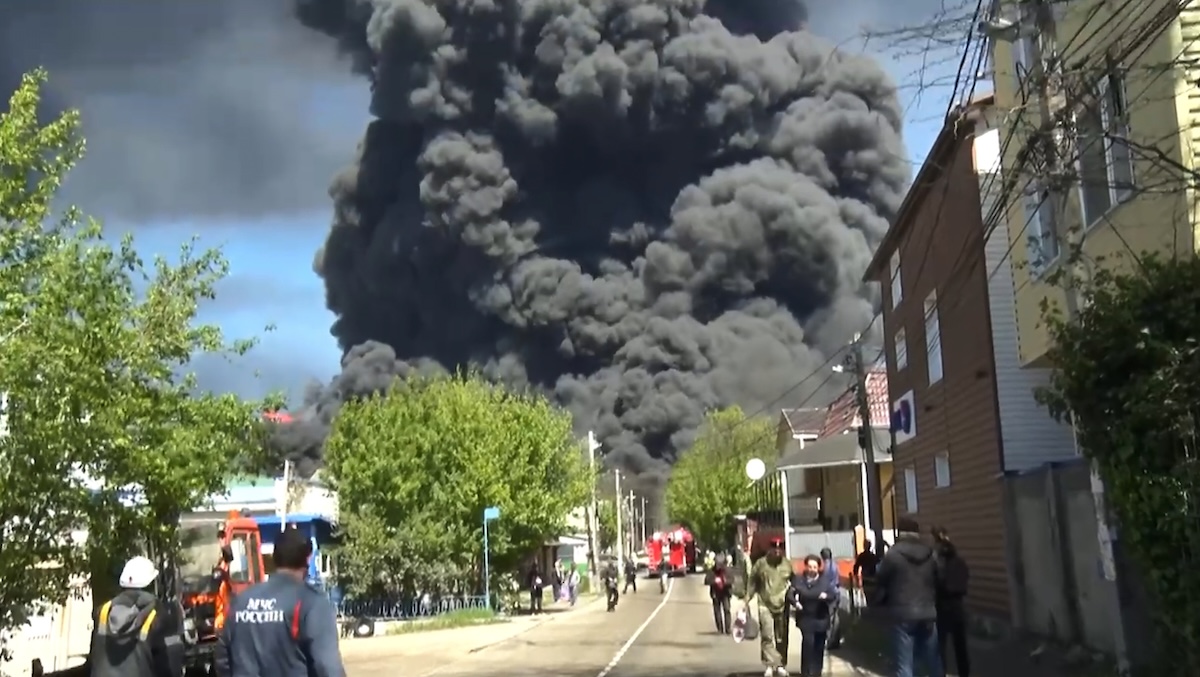
While traveling in Ireland, President Donald Trump pointed to record-high diesel prices and urged Ukrainian President Volodymyr Zelenskyy to halt his military campaigns against Russian oil refineries.
“Mr. Zelenskyy has to do one thing: He has to stop knocking out diesel fuel in Russia,” Trump stated to journalists on Sept. 13. “Let him go after targets, but not diesel fuel, because he’s causing a shortage of diesel fuel. This isn’t done by the Middle East. This is done by what’s happening with Russia and Ukraine. … Don’t hit diesel fuel because that’s hurting the world.”
Trump repeated these remarks during a separate press appearance that same day. By Sept. 14, he took to Truth Social to argue that Ukraine’s strikes on Russia—rather than Iran’s attempts to restrict the Strait of Hormuz—were the primary catalyst for the surge in diesel costs.
Online critics quickly pushed back, arguing that sparing Russian refineries would do little to relieve domestic diesel prices for American truckers, and asserting that blaming Ukraine deflects from Trump’s own military conflict with Iran.
However, energy experts note that although Trump’s argument serves his political narrative, the underlying mechanics are accurate.
The United States has banned direct oil and petroleum imports from Russia since 2022 in response to the invasion of Ukraine. Even so, the drop in Russian production has created a global supply deficit, and because U.S. fuel costs are tied to international markets, American consumers ultimately feel the pinch.
“When diesel fuel becomes scarce elsewhere in the world, it raises prices and leads U.S. companies to export more refined products, including diesel,” explained Kenneth Gillingham, a Yale University energy and environmental economist.
The Current State of Diesel Prices
Within the U.S., diesel prices have jumped from $3.81 right before the Iran conflict to $6.29. Nations like the United Kingdom are experiencing similar multi-year highs. While the average citizen may not purchase diesel directly very often, these expenses are baked into the shipping and trucking costs of nearly all consumer goods.
Analysts point to the increasing frequency of successful Ukrainian drone strikes on Russian energy infrastructure as a major driver behind these pricing pressures.
Prior to the escalation with Iran, Russia and the Middle East combined made up 29% of globally shipped seaborne diesel, according to Skip York, an energy and global oil fellow at Rice University’s Center for Energy Studies.
Yet, by August alone, Russia’s revenues from fossil fuel exports dropped by 8%, data shows from the Helsinki-based Centre for Research on Energy and Clean Air. The research group attributed this largely to Ukrainian drone attacks that paralyzed a vital export terminal for a record nine consecutive days. Additional ports have sat idle or gone months without loading cargo due to earlier strikes.
The degradation of Russia’s export capacity has reached the point where the nation has reportedly had to import fuel from South Korea and repurchase its own crude refined into gasoline in India.
How the Russian Diesel Deficit Affects the U.S. and the World
Countries most reliant on Russian oil include Turkey, China, Brazil, and Singapore. While the U.S. has avoided Russian oil imports for years, Americans still experience indirect financial consequences due to global market integration.
For one, American-made petroleum products are not kept solely for domestic consumption; they are freely traded on international markets.
“The U.S. oil industry exports diesel freely, even when domestic supplies are scarce and domestic prices are spiking,” noted Clark Williams-Derry, an energy finance analyst at the Institute for Energy Economics and Financial Analysis. “If American consumers want to buy diesel, they must bid in a global marketplace against the entire world.”
Consequently, U.S. diesel exports have surged during these Russian shortages, creating “upward pressure on U.S. diesel prices,” York observed.
This situation is further complicated by constrained refinery capacity.
“The challenge is running out of places to refine crude oil into consumer products,” York explained. “U.S. refineries are running at 97% to 98% utilization.” Patrick De Haan, head of petroleum analysis at GasBuddy, estimates that between 60% and 65% of the recent diesel price jump stems from Ukraine’s attacks on Russian infrastructure, with the rest driven by Iranian disruptions near the Strait of Hormuz and other key shipping routes.
“Ukraine is doing what it feels it needs to do to fight back,” De Haan acknowledged, “but factually, it is correct to say that less output from Russia is impactful on diesel prices.”