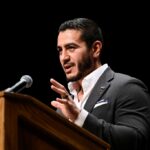
In Michigan’s Democratic U.S. Senate primary, candidate Abdul El-Sayed has questioned the funding behind a recent poll. The survey, conducted by research firm Tavern Research from July 6-7, indicated U.S. Rep. Haley Stevens held a narrow one-point lead over El-Sayed, within the poll’s margin of error.
El-Sayed, known for his progressive stance and critiques of Democratic leadership, is competing against Stevens, a moderate Democrat supported by outgoing Senator Gary Peters and Senate Minority Leader Chuck Schumer. The winner will face Republican Mike Rogers in November.
During a July 8 interview, El-Sayed suggested the poll might be financed by AIPAC, the American Israel Public Affairs Committee, which supports U.S. policies aimed at strengthening ties with Israel. However, no public information has surfaced linking AIPAC to this specific poll. Tavern Research stated that it self-funded the survey, and neither the published results nor any related news reports mentioned AIPAC’s involvement.
Matt Lackey, CEO of Tavern Research, commented that the company conducts polls at its own expense to demonstrate its accuracy. El-Sayed’s campaign did not provide evidence to PolitiFact to support his claim about AIPAC funding. A campaign press release issued on July 16 referenced the poll in a comparison of candidate favorability but made no mention of AIPAC.
AIPAC and its affiliated super PAC, United Democracy Project, have been significant spenders in the Michigan primary, reportedly investing nearly $30 million in advertising favoring Stevens and opposing El-Sayed, marking their largest-ever investment in a single race.
El-Sayed has been critical of Israel’s government and military actions, referring to the conflict in Gaza as a “genocide” and advocating for the cessation of U.S. military aid to Israel. Stevens, on the other hand, has affirmed Israel’s right to exist, supports a two-state solution, while also expressing criticism of Prime Minister Benjamin Netanyahu.
The Tavern Research poll surveyed 2,211 likely Democratic primary voters online. In a head-to-head question, 42% favored Stevens, while 41% supported El-Sayed, with 18% undecided.
Subsequent polls have presented varied results, with some showing larger margins between the candidates. A poll conducted by The Detroit News and WDIV-TV from July 8-11 found Stevens leading by 7 points, while two polls from mid-July, commissioned by groups supporting El-Sayed, indicated he held double-digit leads.
Politico Playbook published the Tavern poll results on July 8, but both Tavern Research and Politico confirmed that Politico did not commission or pay for the survey. Tavern Research typically discloses poll commissioners on its website when it conducts commissioned surveys, but no such disclosure appears for the Michigan primary poll.
The United Democracy Project, AIPAC’s super PAC, has funded polling nationwide, spending over $1 million on polling this election cycle according to Federal Election Commission records. While FEC filings show payments to frequent vendors like Global Strategy Group and Hart Research Associates, there are no records of payments to Tavern Research by the super PAC to date.
Based on the available information, there is no evidence linking AIPAC to the Tavern Research poll. Tavern Research has stated the poll was self-funded. El-Sayed’s campaign has not provided any substantiation for his claim. Consequently, the assertion that the poll was funded by AIPAC is rated as False.
Reference