President Donald Trump has frequently highlighted the stock market’s ascent during his second term, asserting that increases in 401(k) retirement plan balances have enhanced the financial well-being of Americans.
In a speech delivered on June 23 at a Mack truck plant in Macungie, Pennsylvania, Trump stated, "The typical 401(k), as you know, is up almost $30,000 in … 13 months." He had previously made similar assertions, dating back to his State of the Union address on February 24.
While the stock market has indeed experienced growth during Trump’s second term, the reported average gain of $30,000 is not substantiated by available data. This figure is approximately triple the increase found in a comprehensive analysis of 401(k) balances. Furthermore, a growing number of Americans are tapping into their 401(k) funds before retirement to address unforeseen financial challenges.
The White House did not provide any evidence to support Trump’s claim. A spokesperson for the White House commented that "equity markets have hit multiple all-time highs" during the president’s second tenure.
Stock Market Performance During Trump’s Second Term
The Standard & Poor’s 500 index, which tracks a broad range of publicly traded stocks, has shown significant gains since Trump assumed office on January 20, 2025. Between his second inauguration and his State of the Union address in February 2026, when he first cited the $30,000 figure, the S&P 500 increased by approximately 13%. By June 23, the date of his Pennsylvania speech, the S&P 500 had risen by about 24% from his inauguration date.
401(k) Balances: A More Modest Increase
Regarding the gains experienced by typical 401(k) holders, determining a "typical" account balance presents challenges. Factors such as income levels, age, and specific company 401(k) policies can lead to considerable variations in account balances, even before accounting for the asset allocation within those accounts.
Joe Fitter, a senior lecturer in finance at Indiana University’s Kelley School of Business, noted that higher account balances generally result in greater gains.
Fidelity Investments, a major financial institution managing numerous 401(k) plans, offers the most relevant data. The company analyzes balances across more than 26,000 corporate 401(k) plans, encompassing approximately 25 million participants, and provides breakdowns by account holder’s age.
Examining Fidelity’s data for the quarterly periods ending December 31, 2024, and March 31, 2026, allows for a comparison of 401(k) balance growth during the initial 15 months of Trump’s second term. This period closely aligns with the timeframe during which he has been making his claims.
Across 11 age ranges provided by Fidelity, from 20 to 70 and older, the average increase in 401(k) balances was $9,454, which is about one-third of the $30,000 figure cited by Trump. The most substantial average increase for any single age group was seen in the 55 to 59 bracket, with a rise of approximately $16,000.
Experts suggest that average gains might be even lower. Mark A. Johnson, an investments and portfolio management fellow at Wake Forest University’s business school, explained that averages in such data are often influenced by high-balance accounts, implying that the median balance would likely be less than $9,000.
Mark Williams, a finance lecturer at Boston University’s Questrom School of Business, indicated that a $30,000 gain during this period would necessitate a 401(k) balance of at least $200,000. However, this is not a typical amount, as only an estimated 10% to 20% of U.S. adults possess an account of that size. It’s also important to note that balance increases are not solely due to stock market gains; employee and employer contributions also play a role.
Factors Influencing 401(k) Growth Relative to the Market
The percentage increases in 401(k) balances by age group, as reported by Fidelity, do not perfectly mirror the overall stock market’s growth rate. Between December 31, 2024, and March 31, 2026, while the S&P 500 saw an increase of about 11%, the average 401(k) analyzed by Fidelity grew by approximately 6.5%, with some age demographics, particularly younger and older individuals, experiencing smaller gains.
One explanation for this discrepancy is that 401(k) accounts typically hold a diversified portfolio. Williams noted that a standard 401(k) allocation consists of 60% to 65% stocks, with the remainder in less volatile assets like bonds. During the period in question, bond returns were relatively stagnant, which would have suppressed overall 401(k) returns.
Another significant factor is that 401(k) accounts are accessible for withdrawals, albeit often with penalties for early access. While designed for retirement income, withdrawals made before age 59 1/2 may incur a 10% penalty and be subject to income taxes. However, certain circumstances, such as costs related to birth or adoption, disability, disaster recovery, medical emergencies, funeral expenses, or avoiding eviction or foreclosure, may allow for penalty-free early withdrawals.
Vanguard reported in March that hardship withdrawals have become increasingly common. Their data indicated that approximately 6% of participants in their 401(k) plans took hardship withdrawals in 2025, an increase from about 4.8% in 2024 and higher than pre-pandemic levels.
Dorothy C. Kelly, a personal finance lecturer at the University of Virginia’s McIntire School of Commerce, commented that the gains in 401(k) accounts have limited immediate utility for individuals under 59 1/2 facing financial difficulties or rising monthly expenses. She stated, "The net worth of ordinary Americans with retirement accounts may be benefiting from current high stock prices, but a growing illiquid asset such as a retirement account does not help with working Americans’ monthly bills."
Assessment
Trump stated that over the past 13 months, "The typical 401(k) … is up almost $30,000."
While the stock market has seen notable increases during Trump’s second term, a $30,000 rise in typical 401(k) balances is not supported by the data. Fidelity Investments data reveals that between December 31, 2024, and March 31, 2026, the average increase in 401(k) balances was $9,454. No age group studied by Fidelity showed an increase approaching half of Trump’s $30,000 figure.
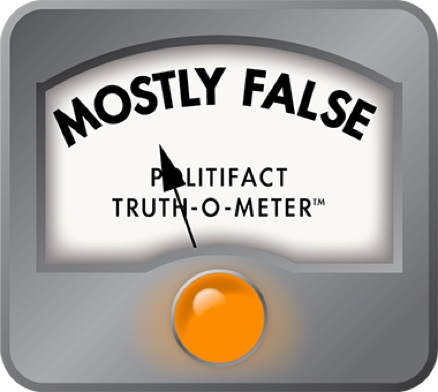
Given that the statement contains an element of truth but omits information that would alter its overall impression, it is rated as Mostly False.