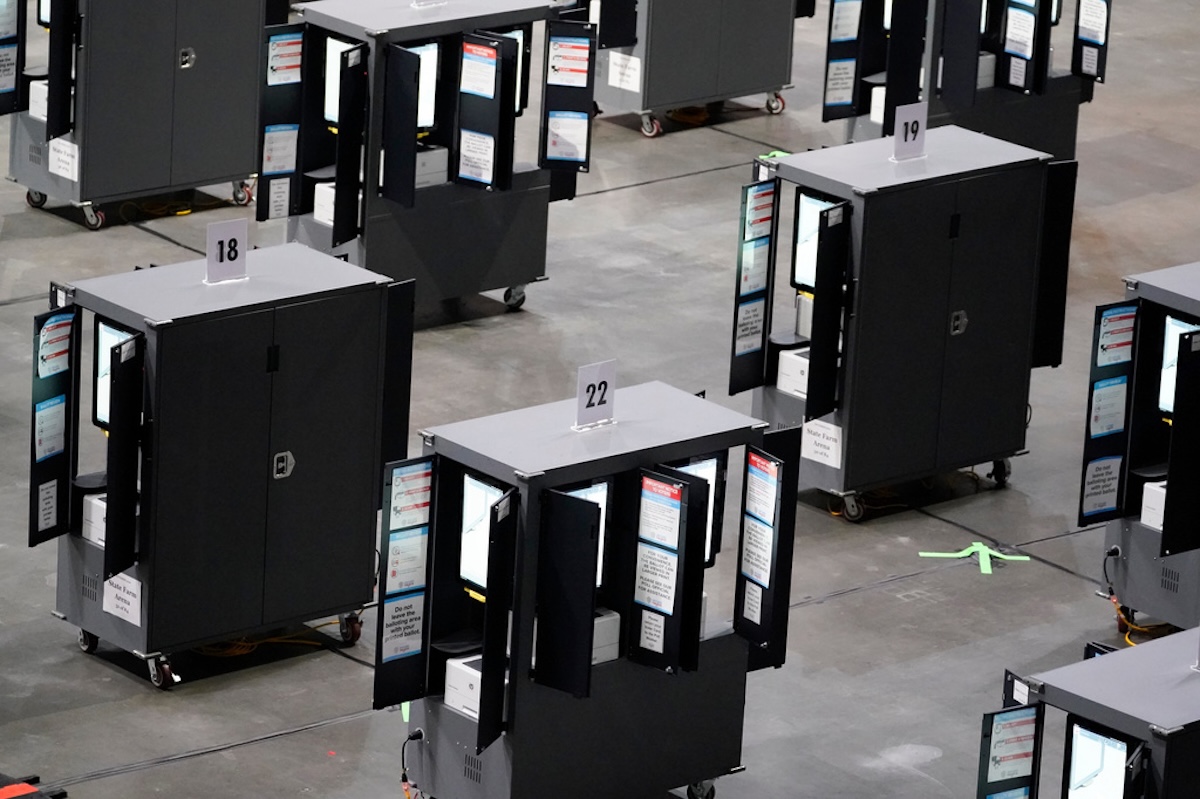
Department of Homeland Security Secretary Markwayne Mullin has asserted that foreign adversaries possess the capability to access and alter votes cast in U.S. elections, a claim that aligns with narratives previously put forth by former President Donald Trump regarding the 2020 election’s integrity. Mullin stated on July 17th that vital components of voting machines are manufactured by entities linked to foreign adversaries, enabling them to access and potentially manipulate voter registration and actual votes. He emphasized that this possibility is a certainty, not a subject for debate.
When approached for further details, the Department of Homeland Security did not provide specifics but reiterated its emphasis on states working to prevent non-U.S. citizens from voting. The White House directed inquiries to the department. It is worth noting that non-U.S. citizens voting in federal elections is exceptionally rare. Furthermore, the process of registering to vote does not involve the use of voting machines.
Mullin’s statements echo long-standing concerns among security and election technology experts regarding the vulnerabilities inherent in voting machines. J. Alex Halderman, a computer science professor at the University of Michigan specializing in electronic voting, explained that hardware attacks could compromise the security controls of voting machines, allowing foreign actors to tamper with them. However, to date, no concrete evidence of such attempts has emerged. Halderman clarified via email that while vulnerabilities exist, there is no proof they have ever been exploited in a U.S. election, nor does their existence indicate an imminent threat of exploitation.
A 2019 report from the U.S. Senate Select Committee on Intelligence concerning Russian interference in the 2016 election also highlighted these risks. The report detailed an experiment at a security conference where participants successfully hacked voting machines to alter votes, install unauthorized software, and perform other illicit actions. This was facilitated by the hackers having physical access to the machines. In real-world election scenarios, officials implement numerous security measures to safeguard voting equipment, including restricted access, secure storage in locked areas with surveillance, and meticulous tracking of machine movements and access.
According to a 2024 assessment by the National Intelligence Council on foreign threats to U.S. elections, voting machines are generally not connected to the internet or to each other.
Halderman was also part of an academic analysis in 2006 that examined the security of electronic voting machines that lacked a reliable paper trail. He testified before the Senate Intelligence Committee in 2017 that their findings were concerning, demonstrating how the machines could be reprogrammed to invisibly alter election outcomes. In a 2021 Georgia court case, Halderman simulated a vote-tampering method involving hidden hardware in a ballot printer to switch candidate selections. However, critics argued that this simulation, conducted with complete machine access granted by the judge, was unrealistic. As former Maricopa County, Arizona, elections administrator Tammy Patrick commented in 2022, leaving keys in an unlocked car and then being surprised by its theft is not a true measure of the car’s security.
Federal intelligence agencies, in a 2021 report, stated they found no evidence of foreign actors attempting to manipulate the 2020 U.S. election process. The report suggested that large-scale interference attempts would likely be detected through physical and cybersecurity monitoring or audits.
Andrew Appel, a professor emeritus of computer science at Princeton University focusing on voting machine technology policy, noted that modern voting machines are generally more secure than those developed around the year 2000. He added that the continued existence of vulnerabilities is why most states still utilize hand-marked paper ballots, which allow for manual recounting and verification.
Reference