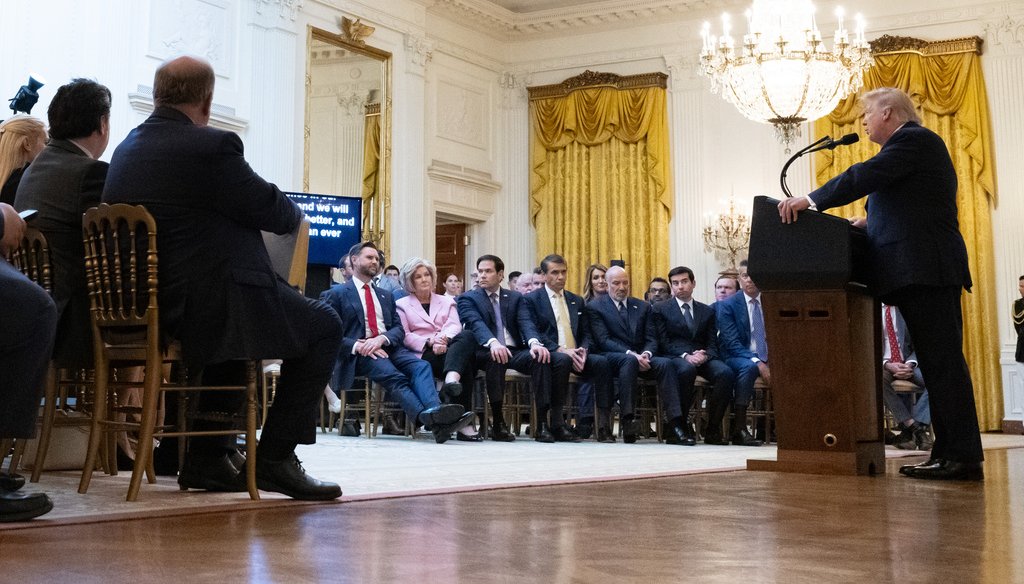
In a recent prime-time address, former President Donald Trump focused on his long-standing claims regarding the 2020 election results, which saw Joe Biden emerge as the victor.
During his nearly 30-minute speech, Trump alleged that foreign nations, particularly China, interfered in the election. He also suggested that elements within the U.S. government, described as the "deep state," concealed crucial information from him and the public. Trump cited declassified and partially redacted intelligence documents, sometimes without clarifying whether proposed Chinese actions matched actual implemented interference. He asserted, "Our elections were left vulnerable to being rigged and stolen, and the trust of the American people was lost," yet offered no specific evidence of altered votes or election outcomes.
Concluding his remarks, Trump advocated for the passage of the SAVE America Act. This proposed legislation would mandate government-issued photo identification for voting and require documentation like a passport or birth certificate for voter registration. The bill faces significant opposition in the Senate, with critics arguing it could disenfranchise voters and create undue burdens on a constitutional right.
Pamela Smith, president of Verified Voting, a nonpartisan organization focused on voting technology, highlighted existing safeguards in U.S. elections. These include pre-election testing of equipment and established protocols for ballot handling. Smith emphasized that the availability of paper ballots in nearly every state serves as a critical tool for verifying voter intent.
Trump’s address did not address the numerous court rulings, intelligence assessments, and expert analyses that concluded there was no direct foreign interference in the 2020 election process.
He also commented on media coverage, criticizing certain networks for not airing his speech live. However, such decisions are not without precedent; major networks previously aired game shows and reruns during a 2022 address by then-President Biden, who accused Trump and Republicans of posing a threat to American democracy.
A closer examination of Trump’s claims regarding China’s alleged interference in the 2020 election follows.
China’s Acquisition of Voter Registration Records Does Not Necessarily Indicate Interference.
Trump initiated his speech by detailing what he described as a "nefarious" Chinese operation to obtain U.S. voter records. He stated, "China carried out what is believed to be the largest compromise of election data in history, resulting in China’s illicit acquisition of 220 million U.S. voter files." He characterized this trove of information, including names, addresses, phone numbers, and party affiliations, as an "unprecedented election security nightmare."
Documents released by the White House indicated that voter registration information from 2013-2021 was publicly available for download from commercial websites and was downloaded by China in 2022. While the documents suggested this data could potentially be used for election influence operations, experts in election data noted that obtaining such information is common.
Ryan Macias, an election security and technology expert with past federal government experience under multiple administrations, stated, "Just because they have voter registration data does not mean that state or local voter registration databases or infrastructure have been breached." He further explained that this data is "information that can be legally purchased by certain members of the public."
Allegations of "Deep State" Cover-ups Are Misleading.
Trump claimed that certain released documents showed "members of the deep state" actively worked to conceal information about China’s alleged election interference from him and the public. This assertion is misleading.
The intelligence community provided Trump with a classified report on foreign interference in January 2021. Two months later, under the Biden administration, the National Intelligence Council released a declassified version. This report indicated that China had considered, but not implemented, influence operations aimed at altering the election’s outcome. Intelligence analysts expressed high confidence in this conclusion.
The report did include a dissenting view from the National Intelligence Officer for Cyber, who believed China attempted to undermine Trump’s reelection primarily through social media and public statements. While this official suggested some efforts might have aimed to indirectly influence candidates and voter preferences, the minority report stated there was "no information suggesting China tried to interfere with election processes."
John Ratcliffe, then Director of National Intelligence, aligned with this minority view in the report.
Documents released by the White House on July 16 did reveal some internal disagreements within the Trump administration concerning China in 2020, but these nuances were already reflected in the 2021 intelligence assessment. The intelligence community typically does not publish all records due to the inclusion of sensitive information that could compromise sources or ongoing investigations.
China’s Stance on Trump and Biden Was Nuanced.
Trump asserted that the Chinese government desired his defeat in the election due to his policies on tariffs and military investment. A CIA note, released alongside Trump’s speech, stated that in mid-2018, the "Chinese Communist Party’s policy was to leverage all domestic and foreign elements that were opposed to the U.S. President in an effort to reduce the U.S. President’s votes and make him resign or prevent his re-election." The CIA note indicated China was working to influence the 2018 and 2020 elections.
Analysis of the 2016 election results by China led to attempts to lobby Trump through representatives from sectors that could be negatively impacted by tariffs. The country also hosted paid speaking engagements for former U.S. government officials and academics.
An assessment by the National Intelligence Council in August 2020 also suggested that China favored Trump’s loss, noting that Beijing "might attempt to more directly thwart the President’s reelection, including by leaking information or through online-influence network."
However, the 2021 intelligence report concluded that China did not view either Trump or Biden’s victory as sufficiently advantageous to risk overt interference. Beijing perceived a bipartisan consensus in the U.S. against China and anticipated challenges regardless of who won the presidency.