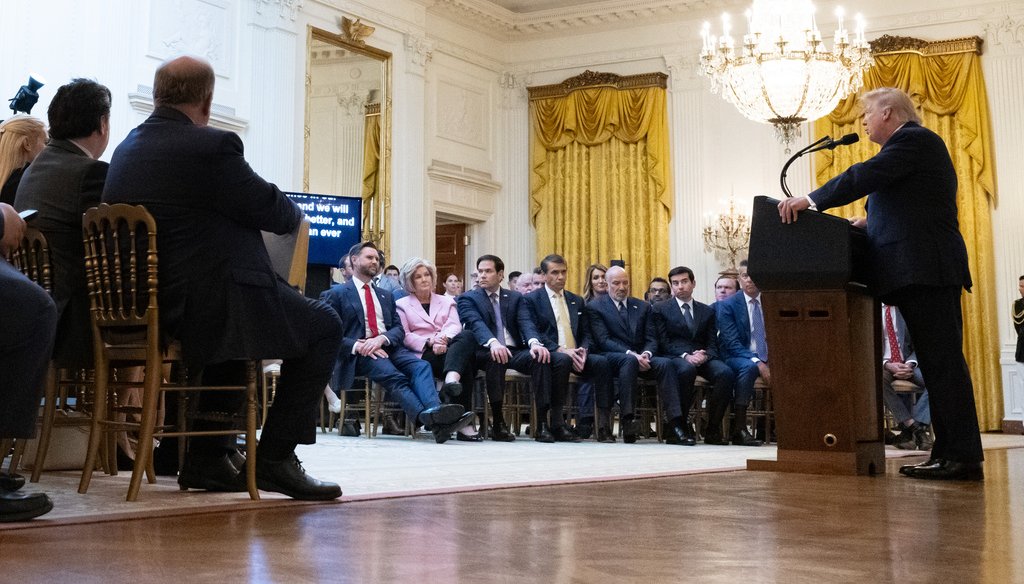
President Donald Trump recently delivered a primetime address, focusing on his long-standing concerns regarding the outcome of the 2020 election. During his nearly 30-minute speech, Trump asserted that foreign adversaries, specifically China, engaged in interference during the 2020 election. He also claimed that elements within the government, referred to as the "deep state," withheld crucial information from him and the public.
Trump referenced intelligence documents, some declassified or redacted, to support his claims about China’s actions, without clearly distinguishing between potential Chinese plans and confirmed activities according to analysts. He stated, "Our elections were left vulnerable to being rigged and stolen, and the trust of the American people was lost," on July 16, though he did not present evidence of altered vote counts or election results.
The President concluded his address by advocating for the passage of the SAVE America Act. This proposed legislation would mandate that voters present government-issued photo identification to cast a ballot and provide proof of citizenship, such as a passport or birth certificate, to register. The bill is currently facing opposition in the Senate, with critics arguing it could disenfranchise voters or create undue burdens on a fundamental right.
Pamela Smith, president of Verified Voting, a nonpartisan organization specializing in voting technology, emphasized the existence of numerous safeguards protecting U.S. elections. These include pre-election testing of voting equipment and established protocols for ballot handling. Smith noted that nearly all states utilize paper ballots, which serve as tangible evidence of voter intent and represent a critical safeguard.
Trump’s speech did not acknowledge the numerous court rulings, intelligence reports, and expert analyses that have indicated a lack of direct foreign interference in the 2020 election process.
He also voiced criticism of certain news networks for not broadcasting his speech live on their main channels. However, such decisions are not without precedent; in 2022, major networks aired other programming during an address by then-President Biden, who had accused Trump and Republicans of threatening American democracy.
A closer examination of Trump’s assertions regarding Chinese interference in the 2020 election reveals the following:
Acquisition of Voter Registration Records by China Does Not Equate to Interference
Trump began his remarks by detailing what he described as a "nefarious" Chinese operation to obtain U.S. voter records, stating, "China carried out what is believed to be the largest compromise of election data in history, resulting in China’s illicit acquisition of 220 million U.S. voter files." He characterized this data, which includes names, addresses, phone numbers, and political affiliations, as an "unprecedented election security nightmare."
Documents released by the White House indicate that voter registration information from 2013-2021 was publicly available for download from commercial websites and that China acquired it in 2022. While the documents suggested this data could theoretically be used for election influence operations, experts in election data have noted that accessing such information is commonplace.
Ryan Macias, an election security and technology expert with prior federal government experience, stated, "Just because they have voter registration data does not mean that state or local voter registration databases or infrastructure have been breached. This data is information that can be legally purchased by certain members of the public."
Claims of "Deep State" Concealment Contradicted by Released Conclusions
Trump claimed that certain released documents indicated that "members of the deep state" actively worked to suppress and downplay information about China’s alleged election interference, withholding it from him and the public. This assertion is misleading.
The intelligence community provided Trump with a classified report on foreign interference on January 7, 2021. Two months later, under the Biden administration, the National Intelligence Council released a declassified version of this report. The report concluded that China had considered, but not implemented, influence operations aimed at altering the election’s outcome, with experts expressing high confidence in this assessment.
A minority view within the report, from the National Intelligence Officer for Cyber, suggested that China’s efforts to undermine Trump’s reelection primarily involved social media and public statements, with some actions intended to indirectly influence candidates, political processes, and voter preferences. However, this minority report explicitly stated, "no information suggesting China tried to interfere with election processes."
John Ratcliffe, who served as the director of national intelligence at the time, aligned with this minority view. The documents released by the White House on July 16 did highlight internal disagreements within the Trump administration in 2020 concerning China, but these discussions were reflected in the 2021 report. The intelligence community typically does not publish all records due to the inclusion of sensitive information, such as details about sources or ongoing investigations.
China’s Stance on Trump’s Reelection: Complex and Nuanced
Trump stated that the Chinese government desired his defeat in the election due to his policies on tariffs and U.S. military investment. A CIA note, released by the White House alongside Trump’s speech, indicated that in mid-2018, the Chinese Communist Party’s policy was to utilize all domestic and foreign elements opposing the U.S. President to reduce his votes and prevent his re-election. The CIA note suggested China was working to influence the outcomes of the 2018 and 2020 elections.
China analyzed the 2016 election results and identified states that could be negatively impacted by tariffs, with the aim of encouraging representatives from these sectors to lobby Trump. The country also extended invitations to former U.S. government officials and academics for paid speaking engagements in China.
A National Intelligence Council assessment from August 2020 also indicated that China would prefer Trump to lose, noting that the country "might attempt to more directly thwart the President’s reelection, including by leaking information or through online-influence network."
However, the 2021 report clarified that China did not view either Trump or Biden winning as sufficiently advantageous to risk overt interference. Beijing recognized a bipartisan consensus against China in the United States and anticipated challenges regardless of which candidate won the election.